
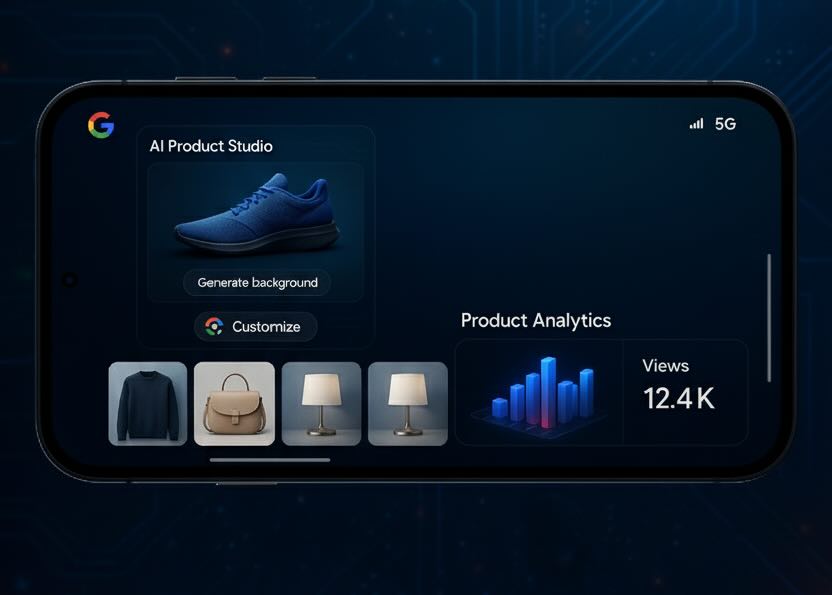
Google’s upgraded Merchant Center has achieved a 25% increase in omnichannel merchant product offerings through its AI-powered Product Studio integration, fundamentally transforming how retailers manage mobile commerce across Google’s ecosystem. The new platform serves as a comprehensive mobile-first hub where retailers can create, optimize, and distribute product listings across Google Search, Shopping, Images, Maps, and YouTube through automated AI content generation and enhanced mobile shopping features.
Product Studio’s AI capabilities have proven transformative for mobile commerce optimization, with 80% of merchants reporting significant efficiency improvements and one-third of AI-generated product images being published or downloaded for immediate use. Over the past two years, the number of businesses using Merchant Center has doubled, signaling a fundamental shift in how retailers approach product discovery on Google’s surfaces.
Product Studio AI: Core Features and Capabilities
Product Studio represents Google’s most ambitious AI toolkit for e-commerce, bundling generative image creation, automated content optimization, and visual enhancement into a single integrated suite. The tool leverages Google’s proprietary generative AI models to produce studio-quality product imagery without requiring physical photoshoots, professional photographers, or complex design software.
The feature set breaks down into several distinct capabilities. Background removal isolates products from cluttered environments in seconds, producing clean white-background images that meet Google Shopping’s quality standards. Resolution enhancement upscales low-quality product photos, improving sharpness and clarity for images that would otherwise fail feed validation. Scene generation creates lifestyle and contextual imagery from text prompts, allowing merchants to place products in seasonal, thematic, or aspirational settings. Image animation converts static product photos into short-form video assets suitable for YouTube Shorts, Performance Max campaigns, and social media distribution.
In December 2025, Google released three additional Product Studio features: AI-generated product titles and descriptions that optimize for search intent, automated video asset creation from existing product images, and a centralized Creative Content hub that aggregates all visual assets from social channels, websites, and Product Studio itself. These assets automatically populate Google Ads libraries, eliminating the manual upload process that previously consumed hours of merchant time each week.
The 25% Omnichannel Listing Increase: Context and Implications
The 25% increase in omnichannel product offerings is not merely a vanity metric. It reflects a measurable expansion in the number of products merchants actively list across multiple Google surfaces simultaneously, including Search, Shopping, Images, Maps, and YouTube. Before the Merchant Center overhaul, many retailers limited their listings to one or two channels due to the complexity of managing product data across fragmented interfaces.
The migration to the new Merchant Center, completed in September 2025, consolidated these channels into a unified dashboard. Combined with Product Studio’s ability to auto-generate optimized assets for each surface, merchants found it significantly easier to expand their product catalog’s reach. Google’s internal data shows that merchants who use Product Studio’s AI image tools list products across an average of 4.2 Google surfaces, compared to 2.7 surfaces for merchants using manually created assets.
For the broader retail industry, this shift means increased competition for organic product visibility on Google. Retailers who delay adoption risk losing share-of-shelf in Google Shopping results to competitors who leverage AI-generated content to populate more surfaces with more products at lower operational cost.
Merchant Center Mobile App Capabilities
The Merchant Center platform now provides a comprehensive set of tools accessible from both desktop and mobile interfaces. The following table summarizes the key capabilities available to merchants in 2026:
| Feature | Description | AI-Powered |
|---|---|---|
| Product Studio Image Generation | Generate lifestyle scenes, remove backgrounds, upscale resolution from text prompts | Yes |
| AI Title and Description Generation | Auto-generate SEO-optimized product titles and descriptions | Yes |
| Creative Content Hub | Centralized video and image asset management across all sources | Yes |
| Performance Max Integration | Automated campaign optimization across Search, Shopping, YouTube, Display | Yes |
| Free Product Listings | Organic product visibility across Google surfaces at no cost | No |
| Local Inventory Ads | Target nearby smartphone users with real-time stock availability | No |
| Promotion Targeting | Audience-specific promotions by customer type or location | No |
| Personalized Growth Insights | AI-driven recommendations based on product and performance analysis | Yes |
| Merchant API (v2) | Programmatic product data management replacing Content API by August 2026 | No |
| Agency Dashboard | Multi-client portfolio management for agencies (US and Canada) | No |
How Small Businesses Benefit
Product Studio’s most significant impact falls on small and mid-sized retailers who previously lacked the budget for professional product photography. A 2025 survey found that 76% of small businesses adopting AI photography tools reported cost savings exceeding 80% compared to traditional photoshoot expenses. Tasks like background removal and image cropping that once consumed hours now complete in minutes.
The free listings feature removes the advertising cost barrier entirely. Small retailers can surface products across Google Search, Shopping, and Maps without spending a dollar on ads. When combined with Product Studio’s zero-cost image generation, a small business owner can create a complete, multi-channel product presence from a smartphone in under 30 minutes per product.
Google’s March 2026 launch of Merchant Center for Agencies adds another layer of accessibility. Small businesses that work with marketing agencies now benefit from streamlined portfolio management, with agencies reporting time savings of up to 12 hours per week through the unified client dashboard. This efficiency gain translates directly into lower management fees for small business clients.
Platform Comparison: Google Merchant Center vs. Shopify vs. Amazon Seller Central
Retailers evaluating their e-commerce stack need to understand how Google Merchant Center fits alongside other major platforms. The three serve fundamentally different roles in the commerce ecosystem:
| Criteria | Google Merchant Center | Shopify | Amazon Seller Central |
|---|---|---|---|
| Primary Function | Product discovery and visibility engine | Full e-commerce storefront platform | Marketplace with built-in audience |
| Monthly Cost | Free (ads optional) | $39–$399/month + transaction fees | $0.99/item or $39.99/month |
| AI Image Tools | Product Studio (free, built-in) | Third-party apps required | A+ Content tools (limited) |
| Audience Reach | 8.5 billion daily Google searches | Depends on merchant’s own traffic | 310 million active buyers |
| Brand Control | Limited to product listings | Full storefront customization | Limited within marketplace template |
| Fulfillment | Not provided | Shopify Fulfillment Network | FBA (Fulfillment by Amazon) |
| Integration | Native Shopify sync | Google, Amazon, social channels | Limited external integrations |
The critical distinction: Google Merchant Center is not a competitor to Shopify or Amazon but a complementary distribution layer. Shopify merchants can sync their product catalog directly to Merchant Center through the native Google channel integration, while Amazon sellers can use Merchant Center to capture search traffic that Amazon’s own SEO does not reach. The most effective e-commerce strategies in 2026 treat all three as interconnected nodes in a unified omnichannel attribution framework.
Best Practices for Product Feed Optimization
Even with AI-generated assets, feed quality determines visibility. Dennis Moons, founder of Store Growers and a Google Ads specialist with over 12 years managing Shopping campaigns, emphasizes the 80/20 rule: “Optimize your top 50 products first and stop trying to optimize 500. The returns diminish sharply after your best-performing SKUs are dialed in.”
The following best practices apply to Google Shopping feeds in 2026:
- Titles: Front-load brand name, product type, and key attributes. Keep under 150 characters to avoid truncation. Use natural language that matches search intent rather than keyword-stuffed strings.
- Descriptions: Go beyond specifications. Explain use cases, benefits, and differentiators. Product Studio’s AI description generator provides a solid starting point, but manual refinement improves click-through rates by 15–20%.
- Images: Use Product Studio to generate multiple angles and lifestyle contexts. Google’s algorithm favors listings with 3+ high-quality images. Minimum resolution: 800×800 pixels for apparel, 100×100 for all other categories.
- Structured data attributes: The 2026 Merchant Center updates added dozens of new data attributes designed for conversational commerce surfaces like AI Mode, Gemini, and Business Agent. Include compatible accessories, substitutes, and answers to common product questions.
- Shipping and pricing: Populate handling time, transit days, and installment pricing fields. Mobile shoppers abandon carts 68% of the time when shipping details are unclear.
- Update frequency: Refresh feeds at least daily. Use the new Merchant API (replacing Content API before August 2026) for real-time inventory synchronization.
Mobile-First Shopping Integration and Performance
Over 70% of Google Shopping searches now occur on smartphones and tablets, making mobile optimization non-negotiable for product feed performance. The September 2025 Merchant Center migration introduced Performance Max campaigns that automatically optimize for mobile conversion patterns, local inventory ads targeting nearby smartphone users, and dynamic remarketing that follows mobile browsing behavior across Google’s ecosystem.
Google Shopping ads now appear seamlessly integrated within mobile search results, benefiting from Google AI Overviews reaching 2 billion users. The platform’s expansion into YouTube shopping integration provides retailers access to mobile video commerce opportunities where users can purchase products directly from mobile YouTube experiences, creating a closed-loop commerce environment that tracks from impression through purchase.
The April 2025 specification updates introduced enhanced mobile shopping features including detailed shipping attributes showing business days for handling and transit, installment pricing displays optimized for mobile checkout flows, and EU energy efficiency labels that comply with mobile commerce regulations. Combined with GA4’s enhanced e-commerce dimensions for deeper analysis, retailers now have end-to-end visibility into mobile shopping performance from product impression to post-purchase behavior.
What Comes Next: Agentic Commerce and Conversational Discovery
Google’s roadmap signals a shift toward agentic commerce, where AI agents handle product discovery and purchasing on behalf of consumers. The company announced dozens of new Merchant Center data attributes specifically designed for AI-driven surfaces like AI Mode, Gemini, and the forthcoming Business Agent. These attributes enable AI systems to answer detailed product questions, suggest compatible accessories, and recommend substitutes without requiring the consumer to visit a product page.
For retailers, this evolution means that product data quality will matter more than ever. Listings with comprehensive, structured attributes will surface in AI-mediated shopping conversations, while sparse listings will be filtered out entirely. The merchants who invest in feed optimization now will be positioned to capture demand as conversational commerce becomes the dominant shopping interface over the next 12 to 18 months.