
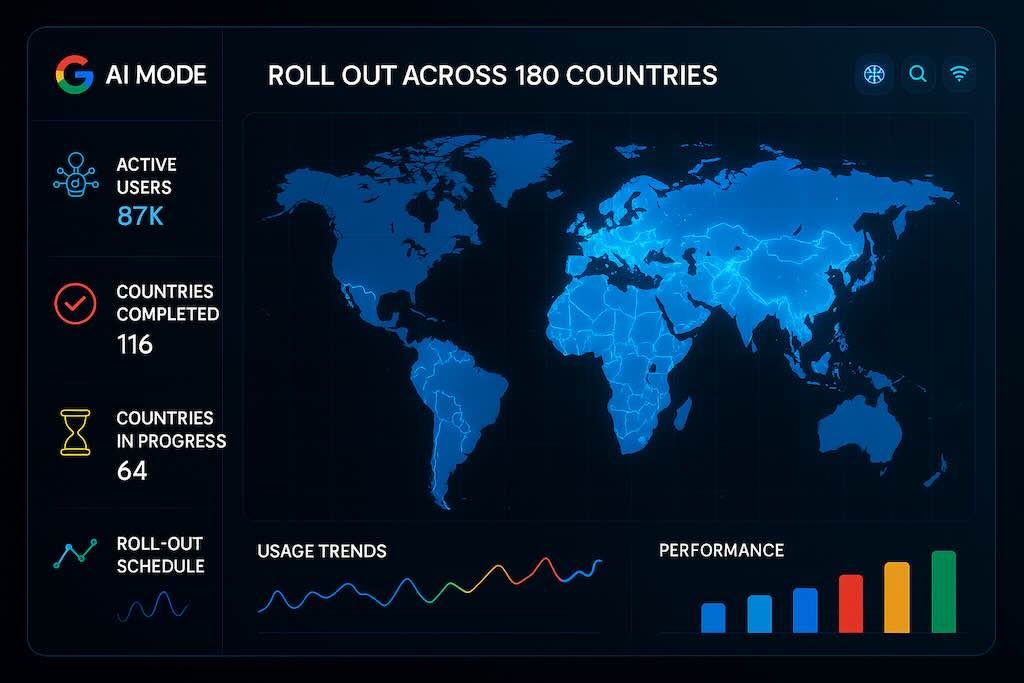
Google AI Mode has expanded to 180 countries and territories, marking the search giant’s most aggressive push toward AI-first search experiences. Simultaneously, Google is testing click encouragement features designed to balance AI-powered answers with publisher traffic concerns. The global rollout, powered by Gemini 2.5, introduces agentic capabilities, enhanced STEM performance, and personalization features that fundamentally reshape how users interact with search results.
The expansion comes amid heated debate about AI search’s impact on website traffic. Independent research from Seer Interactive shows organic CTR plummeted 61% for queries where AI Overviews appear, while Press Gazette reports that global publisher traffic from Google dropped by a third in the year to November 2025. Google disputes these figures, but its active testing of click encouragement features suggests internal awareness that AI-generated answers may be reducing traditional website visits.
What Google AI Mode Is and How It Works
Google AI Mode is an end-to-end AI search experience powered by Gemini 2.5 that transforms traditional search into an interactive, conversational interface. Unlike standard Google Search, AI Mode eliminates the familiar ten blue links in favor of comprehensive AI-generated responses with inline citations. Users access it through a dedicated tab in Google Search, where they can ask complex, multi-part questions and receive detailed answers synthesized from multiple web sources.
The system runs multiple searches simultaneously behind the scenes. For a single user query, AI Mode may execute several related searches, combining results into a cohesive response that addresses nuances a traditional keyword search would miss. This approach makes it particularly effective for research-heavy queries—comparing enterprise software across a dozen criteria, planning multi-city travel itineraries, or analyzing technical specifications across competing products.
AI Mode also introduces agentic capabilities. Users in the United States who subscribe to Google AI Ultra can use it to find and book restaurant reservations, with local service appointments and event tickets planned for future releases. The system remembers context from prior interactions, enabling personalized responses that improve with use. A link-sharing function allows users to share AI Mode conversations so others can pick up where the discussion left off.
AI Mode vs AI Overviews: Key Differences
These two features represent distinct approaches to AI-powered search. Understanding the difference matters for SEO strategy. A comprehensive Ahrefs study of 730,000 response pairs reveals that despite 86% semantic similarity in conclusions, the two systems cite entirely different sources—with only 13.7% citation overlap.
| Feature | AI Overviews | AI Mode |
|---|---|---|
| Activation | Automatic—appears above search results | Opt-in—user selects the AI Mode tab |
| Response length | Short summary (1-2 paragraphs) | 4x longer on average |
| Follow-up questions | Not supported | Full conversational threading |
| Traditional results | Displayed below the overview | Eliminated entirely |
| Wikipedia citations | 18.1% of responses | 28.9% of responses |
| Quora citations | Baseline rate | 3.5x higher than AI Overviews |
| Agentic tasks | Not available | Bookings, reservations, multi-step tasks |
| Availability | 200+ countries, 40+ languages | 180 countries, expanding languages |
The low citation overlap carries significant implications. Being featured in an AI Overview does not guarantee visibility in AI Mode. Marketers need to treat these as separate channels with overlapping goals but different optimization requirements.
Global Rollout Details: 180 Countries and Expanding Languages
Until August 2025, Google AI Mode was available only in the United States, United Kingdom, and India. The expansion to 180 countries initially launched in English, with five additional languages added by September 2025: Hindi, Indonesian, Japanese, Korean, and Brazilian Portuguese. Google has committed to adding more languages in subsequent phases.
This rollout coincides with AI Overviews reaching over 200 countries and 40+ languages, meaning virtually every Google user now encounters some form of AI-generated search content. The EU market received particular attention, with Google experimenting with an “Ask Anything” box that leads directly to AI Mode conversations—a notable move given European regulators’ scrutiny of AI-powered features.
The updated AI model powering the expansion delivers enhanced performance specifically for STEM queries, addressing a previous weakness in handling complex scientific and mathematical questions. Google also deployed compare checkboxes for products and local business listings, along with “People Also Search For” integration within AI Mode results.
Click Encouragement Features Explained
Google’s testing of click encouragement features represents an acknowledgment that AI-generated answers need to coexist with the publisher ecosystem. Several interface experiments are currently in progress:
- Deep dive buttons — Placed alongside AI responses, these prompt users to explore source material in greater depth, creating a direct pathway to publisher websites.
- Rounded search result snippets — Redesigned visual treatment for traditional results that appear alongside AI answers, making them more visually prominent and clickable.
- Sticky search bars — Persistent navigation elements that keep traditional search accessible even when users are engaged with AI Mode responses.
- Preferred sources features — Deployed in the US and UK, this gives high-quality publishers enhanced visibility in Top Stories results.
- AI Overview explanations with overlay tests — Knowledge panel integration that provides additional context about cited sources.
These features signal a strategic pivot. Rather than treating AI answers and website traffic as zero-sum, Google appears to be designing interface elements that make clicking through to sources a natural extension of the AI experience. However, it remains unclear whether these features will offset the documented CTR declines.
Impact on Organic Traffic and SEO
The data on AI search’s impact on organic traffic is stark. According to multiple independent studies, the introduction of AI-generated answers has fundamentally altered click behavior:
- Organic CTR dropped 61%—from 1.76% to 0.61%—for queries with AI Overviews (Seer Interactive, September 2025)
- The top organic link’s CTR fell approximately 79% when AI Overviews appear (Authoritas)
- Zero-click searches increased from 56% to 69% between May 2024 and May 2025
- AI Overviews now appear on 48% of tracked queries, up from 31% in February 2025
- Global publisher traffic from Google declined by a third year-over-year
Google’s head of Search, Liz Reid, has publicly disputed these findings. In an August 2025 statement, she claimed that “average click quality has increased” and that Google was “sending slightly more quality clicks to websites than a year ago.” Reid argued that AI Overviews cause users to search more and ask longer, more complex questions, generating different types of traffic. However, as ChatGPT usage triples while Google’s market share declines to 66.9%, the competitive pressure from AI-native search alternatives adds urgency to the traffic question.
Meanwhile, brands cited in AI Overviews earn 35% more organic clicks and 91% more paid clicks compared to non-cited brands on the same queries. This creates a winner-take-all dynamic where citation-based visibility matters more than traditional ranking positions.
What Marketers Should Do Now
The expansion of Google AI Mode to 180 countries demands immediate strategic adjustments. Marketers who wait risk losing visibility in the fastest-growing search interface. Here are the priority actions:
Treat AI Mode and AI Overviews as separate channels. With only 13.7% citation overlap, optimizing for one does not guarantee visibility in the other. Audit your content’s appearance in both interfaces and track citation rates independently.
Prioritize topical authority over individual page rankings. AI Mode cites domains that demonstrate broad expertise. Wikipedia appears in 28.9% of AI Mode citations because it covers topics comprehensively. Build content clusters that establish your site as the definitive resource in your niche.
Structure content for AI readability. Modular, well-organized content with clear headings, tables, and structured data performs better in citation selection. AI Mode’s underlying model favors content that directly answers specific questions in discrete, extractable sections.
Build third-party brand mentions. AI Mode’s citation algorithm considers domain reputation across the web, including forums, directories, and independent mentions. Invest in digital PR and thought leadership that generates organic brand citations beyond your own properties.
Monitor AI search performance. Tools from Ahrefs and Semrush now offer AI citation tracking. Integrate these into your reporting alongside traditional rank tracking to capture the full picture of search visibility.
Industry Perspective: Navigating the AI Search Transition
The industry response to Google AI Mode’s expansion has been mixed. Publishers express concern over traffic erosion, while some analysts see opportunity in the new citation-based visibility model.
“With AI Overviews, people are searching more and asking new questions that are often longer and more complex. The clicks that publishers are receiving are actually better for them.”
— Liz Reid, VP and Head of Google Search, Search Engine Land interview
However, publishers remain skeptical. Press Gazette reported that industry leaders have urged Google to “stop the BS” regarding claims that AI features haven’t harmed website click-throughs. The disconnect between Google’s internal data and independent research continues to fuel debate about the true economic impact of AI-powered search on the broader web ecosystem.
The 180-country AI Mode rollout represents Google’s most significant search transformation since the original launch of Google Search. As AI Overviews reach 2 billion monthly users and Gartner’s prediction about AI chatbots cutting search traffic faces its deadline, marketers must adapt their strategies for a search landscape where AI-generated answers are the default experience rather than the exception. The winners in this transition will be those who optimize for citation-based visibility while building the topical authority and brand reputation that AI systems rely on for source selection.