
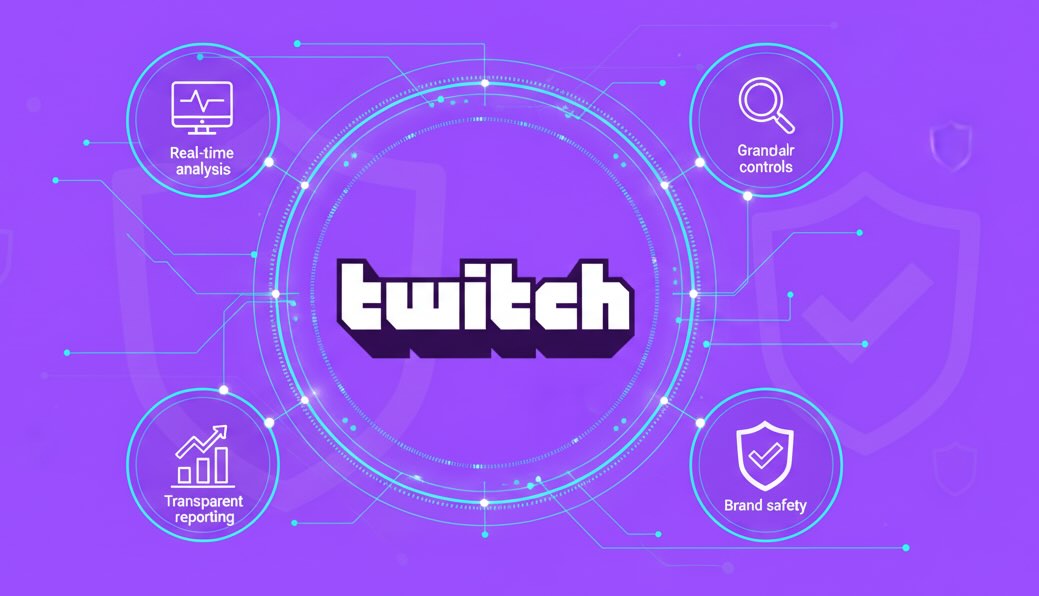
Twitch has implemented advanced brand safety measures through AI-powered content moderation systems that have achieved a 97% advertiser confidence rating while maintaining the platform’s authentic streaming culture. The comprehensive system combines real-time content analysis, automated channel categorization, and sophisticated brand safety controls that enable advertisers to protect brand reputation while accessing Twitch’s highly engaged gaming and entertainment audiences.
With the global content moderation market reaching $11.63 billion in 2025 and projected to hit $23.20 billion by 2030 at a 14.75% CAGR, Twitch’s investment in AI-driven moderation reflects a broader industry shift. The platform processes millions of concurrent streams daily, making manual oversight impossible at scale. Twitch’s solution combines machine learning classifiers, natural language processing for chat analysis, and computer vision for video frame inspection to deliver near-instantaneous brand safety assessments across its entire content library.
How Twitch’s AI Content Moderation System Works
Twitch’s moderation architecture operates on three layers. The first layer uses automated AI detection that scans live video feeds, audio streams, and chat messages simultaneously. Machine learning models trained on millions of hours of streaming content identify mature themes, explicit language, controversial topics, and brand-inappropriate material in real time. The second layer relies on community moderators — volunteers appointed by individual streamers — who handle channel-specific enforcement and edge cases that AI cannot reliably classify.
The third layer involves Twitch’s internal safety operations team, which handles escalated cases, updates moderation policies, and retrains AI models based on emerging content patterns. This hybrid approach mirrors what research firm Foiwe identified in its 2026 State of AI Content Moderation report: leading platforms now use AI to handle 85-95% of routine content flagging while human reviewers resolve the remaining complex decisions. For live streaming specifically, the challenge is acute — content is generated every second across thousands of simultaneous broadcasts, and manual review systems simply cannot match the pace.
The system categorizes streams across gaming genres, talk shows, creative content, IRL broadcasts, and emerging formats like co-streaming. Each category carries its own risk profile, and the AI adjusts advertiser placement thresholds accordingly. A Just Chatting stream, for example, faces different linguistic screening parameters than a rated-M game broadcast.
The 97% Advertiser Confidence Metric in Context
The 97% advertiser confidence figure represents the proportion of ad placements that met or exceeded brand safety thresholds set by participating advertisers during Twitch’s internal measurement period. This metric tracks whether ads appeared alongside content that aligned with each advertiser’s predefined safety criteria — including content category, language filters, and audience demographic parameters.
For context, industry benchmarks from verification vendors like IAS and DoubleVerify typically report brand safety rates of 95-98% across major platforms when using their full suite of pre-bid and post-bid filtering tools. Amazon Rekognition, Amazon’s own computer vision service used across its properties, reports approximately 80% accuracy for content identification, while leading specialized systems achieve over 95%. Twitch’s 97% figure positions the platform competitively, though it is worth noting that advertiser-reported confidence and third-party verified brand safety rates can differ depending on measurement methodology.
DoubleVerify expanded its measurement capabilities to Amazon Custom Audiences for Twitch inventory in November 2023, providing independent verification that advertisers can layer on top of Twitch’s native safety tools. Amazon DSP also added content exclusion categories for brand suitability control in December 2025, giving advertisers unified controls to block specific topics across both Twitch and third-party inventory.
Brand Safety Tools: Twitch vs YouTube vs Meta vs TikTok
Each major platform takes a different approach to brand safety, shaped by content format, ad delivery infrastructure, and regulatory pressure. The table below compares key capabilities as of early 2026.
| Feature | Twitch | YouTube | Meta (FB/IG) | TikTok |
|---|---|---|---|---|
| Content Format | Live streaming + VOD | VOD + live + Shorts | Feed posts, Reels, Stories | Short-form video |
| AI Moderation | Real-time video, audio, chat | Pre-upload + real-time scan | Pre-publish + feed ranking | Pre-publish + in-feed |
| GARM Compliance | Via Amazon DSP | Native + DV/IAS | Native + DV/IAS | Native + IAS |
| 3rd-Party Verification | DoubleVerify | IAS, DV, Zefr | IAS, DV | IAS, DV, Zefr |
| Channel Whitelisting | Yes | Yes (YouTube Select) | Publisher lists | Limited |
| Keyword Blocking | Yes | Yes | Yes | Yes |
| Content Category Exclusions | Via Amazon DSP | Native inventory modes | Topic exclusions | Category filters |
| Live Content Challenge | High (primary format) | Moderate | Low | Low |
| Avg. CPM Range | $4-$12 | $5-$30 | $3-$15 | $3-$10 |
The critical distinction: YouTube offers advertisers more granular native controls through inventory modes and YouTube Select, which enable contextual targeting beyond simple keyword blocking. Twitch routes much of its advanced brand suitability tooling through Amazon DSP, reflecting Amazon’s ownership of the platform. Meta and TikTok primarily moderate pre-published content, which is inherently less risky than Twitch’s live-first environment where topics and tone shift unpredictably mid-broadcast.
How Advertisers Can Leverage Twitch Safely
Twitch provides a layered set of advertiser controls: content category selection, channel whitelisting and blacklisting, keyword filtering, and audience demographic targeting. Advertisers running campaigns through Amazon DSP gain additional content exclusion categories introduced in late 2025 that block specific topics across both Twitch and third-party inventory through unified controls.
The Twitch Bounties program, which automates sponsorship matchmaking between brands and streamers, implements vetting algorithms to ensure brand safety before pairing advertisers with creators. If automated checks flag content, Twitch moderators review it manually, and payouts pause until resolution. For larger campaigns, Twitch offers transparency reporting with detailed analytics on content contexts where ads appeared, audience engagement metrics, and brand safety compliance data — similar to how Amazon DSP’s privacy sandbox integration provides attribution visibility.
Twitch has also been testing “Brand Safety Scores” that rate individual streamers based on chat behavior, ban history, manual ratings from Twitch staff, partnership status, and channel age. Though not yet publicly launched — a Twitch spokesperson confirmed “nothing has launched yet” — the system would give advertisers granular, per-creator risk assessments. Average CPM rates on Twitch range from $4 to $10, rising to $12+ during peak periods in Q4, making it a cost-competitive alternative to YouTube’s $5-$30 range.
Impact on the Live Streaming Ad Market
The live streaming market is projected to grow by $25.89 billion between 2026 and 2030, expanding at a 17.9% CAGR. Within this landscape, brand safety infrastructure is not merely a compliance checkbox — it directly determines which advertisers are willing to allocate budget to live content. In the US, 56% of ad views on connected TV platforms already occur in live environments, driven by sports coverage and FAST channels, and nearly 47% of advertisers expect CTV inventory to become fully biddable through programmatic channels.
Twitch’s brand safety improvements position it to capture a larger share of the broader video advertising market, which grew from $82.68 billion in 2025 to an estimated $90.88 billion in 2026 and is forecast to reach $145.97 billion by 2031. The platform’s ability to attract premium advertisers who previously avoided gaming and streaming content due to brand risk concerns opens new revenue streams. This matters for creators too — Twitch Partners with 1,000 concurrent viewers typically earn $3,000-$5,000 monthly from ads alone, and higher-value brand partnerships could push those figures upward.
The programmatic advertising market, projected to reach $725-$834 billion globally by 2026, increasingly demands automated brand safety verification. Twitch’s integration with Amazon DSP and third-party verification vendors like DoubleVerify positions the platform within this programmatic ecosystem, much as Google’s AI Overviews reaching 2 billion users is reshaping where and how ad dollars flow across search and content platforms.
Challenges and Limitations of AI Moderation on Live Platforms
Despite the 97% confidence metric, significant challenges remain. Live content is inherently harder to moderate than pre-recorded video because decisions must be made in milliseconds, not minutes. AI models struggle with context-dependent content: sarcasm, cultural references, in-jokes within gaming communities, and rapidly shifting conversational tone can all trigger false positives or slip past automated filters.
Twitch’s reliance on volunteer community moderators introduces inconsistency. Unlike YouTube’s centralized moderation infrastructure, Twitch’s moderators are unpaid volunteers appointed by individual streamers, and enforcement standards vary significantly across channels. The Brand Safety Institute has noted that this decentralized model creates a “balancing act” between platform-level safety standards and the authentic creator culture that drives audience engagement.
There is also the “Twitch Adpocalypse” concern — periods where advertiser pullbacks due to safety incidents reduce creator revenue across the platform, including streamers whose content was never problematic. This mirrors challenges seen across social media, where broad safety responses to individual incidents can have disproportionate effects. As Manisha Mehta, Bynder’s Global PR and Communications expert, noted: “While AI is certainly efficient, this doesn’t mean it is risk-free, and without proper governance, it can introduce misaligned messaging and even reputational risks.”
Privacy considerations add another layer of complexity. As 78% of consumers demand ethical AI practices and regulators tighten data protection rules, Twitch must balance its AI moderation capabilities with user privacy expectations — particularly around behavioral profiling used in brand safety scoring.
What Comes Next for Twitch Brand Safety
Twitch’s trajectory points toward deeper Amazon ecosystem integration, more granular per-creator safety scoring, and expanded third-party verification partnerships. The GARM (Global Alliance for Responsible Media) framework, developed by the World Federation of Advertisers, is becoming the standard benchmark that platforms must meet to retain premium advertiser spend. Both IAS and DoubleVerify map their brand safety tiers to GARM categories, and Twitch’s compliance through Amazon DSP aligns the platform with this industry direction.
The platform’s new roles — Lead Moderator and Creator Representative — signal a move toward more professionalized moderation that bridges the gap between volunteer community management and platform-level brand safety requirements. Combined with advances in multimodal AI that can simultaneously analyze video, audio, and text (a topic explored in an ICCV 2025 workshop paper comparing AI and human moderators), Twitch’s moderation accuracy should continue improving. For advertisers evaluating live streaming inventory, the data suggests Twitch has built a credible brand safety infrastructure — though independent verification through tools like DoubleVerify remains essential for brands operating at scale, similar to how Google Merchant Center’s AI-driven tools require ongoing quality monitoring to maintain effectiveness.