
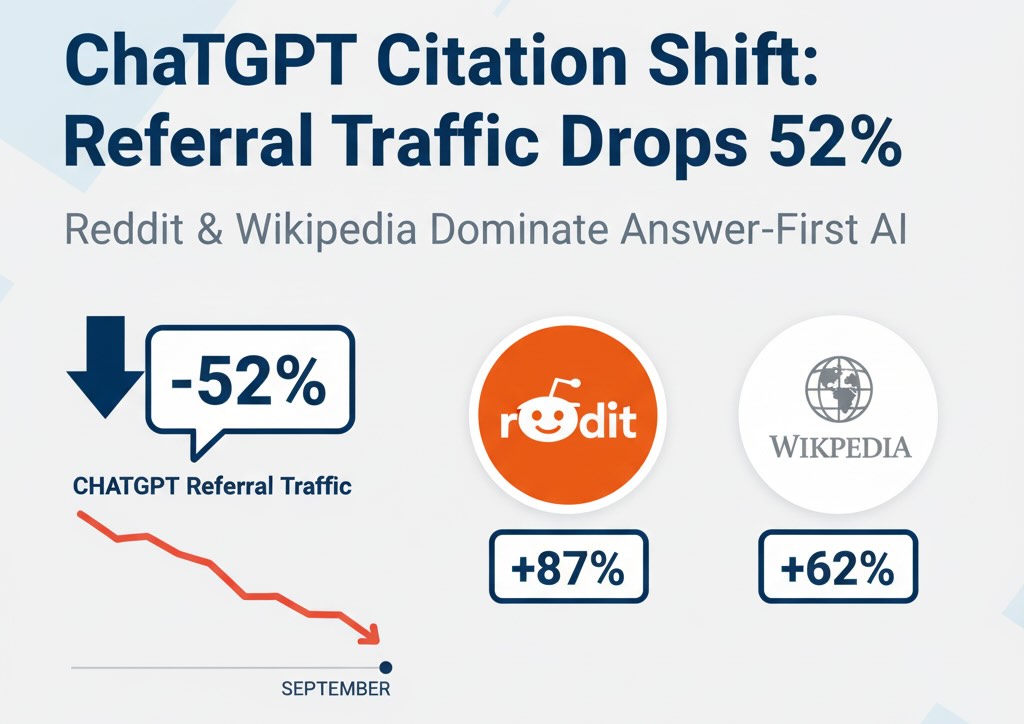
ChatGPT referral traffic has declined 52% since July 21, 2025, as OpenAI fundamentally restructures its citation methodology to favor “answer-first” sources. Reddit citations surged 87% to capture over 10% of all references, while Wikipedia climbed 62% to nearly 13% of total citations. This dramatic shift toward community-driven platforms reflects ChatGPT’s evolution from broad source diversity toward concentrated reliance on direct-answer content, creating new challenges for businesses as ChatGPT usage triples and Google market share drops to 66.9%.
ChatGPT Citation Data Breakdown: Reddit and Wikipedia Surge
The numbers tell a clear story of consolidation. According to analysis by Profound’s Josh Blyskal, who examined more than 1 billion ChatGPT citations and 1 million referral visits, the platform’s sourcing behavior changed abruptly in late July 2025. OpenAI appears to have manually reweighted its retrieval system weeks before GPT-5’s August 7 launch, prioritizing platforms that deliver direct answers over marketing-oriented content.
Reddit’s 87% citation increase since July 23 pushed the platform past 10% of all ChatGPT references. Wikipedia rose 62% from its July low to claim nearly 13% of citation share, an all-time high. Together with TechRadar, these top three domains now control 22% of all ChatGPT citations, a 53% increase in just one month. That means roughly 1 in 5 ChatGPT responses now links to just three websites.
Broader research from Profound’s dataset of 680 million citations across ChatGPT, Google AI Overviews, and Perplexity reveals distinct sourcing philosophies. ChatGPT demonstrates what researchers call an “authoritative knowledge preference,” while Perplexity leans heavily on Reddit (46.7% of its top 10 citations) and Google AI Overviews balances across Reddit (21.0%), YouTube (18.8%), and Quora (14.3%).
Top 20 Most-Cited Domains by ChatGPT
Multiple independent studies from Ahrefs, Semrush, and Profound have mapped ChatGPT’s citation landscape. The following table synthesizes data from these analyses, showing the domains that appear most frequently in ChatGPT responses with active citations.
| Rank | Domain | Share of Top 10 Citations | Category |
|---|---|---|---|
| 1 | Wikipedia (en.wikipedia.org) | 47.9% | Encyclopedia |
| 2 | Reddit (reddit.com) | 11.3% | Community Forum |
| 3 | Forbes (forbes.com) | 6.8% | Business Media |
| 4 | G2 (g2.com) | 6.7% | Software Reviews |
| 5 | TechRadar (techradar.com) | 5.5% | Tech Media |
| 6 | Amazon (amazon.com) | 3.4% | E-commerce |
| 7 | Business Insider (businessinsider.com) | 1.3% | Business Media |
| 8 | Wired (wired.com) | 1.2% | Tech Media |
| 9 | The Verge (theverge.com) | 1.1% | Tech Media |
| 10 | Healthline (healthline.com) | 1.0% | Health |
| 11 | Wikipedia (es.wikipedia.org) | ~0.9% | Encyclopedia |
| 12 | The Sun (thesun.co.uk) | ~0.8% | News |
| 13 | Times of India (timesofindia.com) | ~0.7% | News |
| 14 | Investopedia (investopedia.com) | ~0.7% | Finance |
| 15 | WebMD (webmd.com) | ~0.6% | Health |
| 16 | Wikipedia (de.wikipedia.org) | ~0.6% | Encyclopedia |
| 17 | Quora (quora.com) | ~0.5% | Community Q&A |
| 18 | CNET (cnet.com) | ~0.5% | Tech Media |
| 19 | Medium (medium.com) | ~0.4% | Publishing Platform |
| 20 | PCMag (pcmag.com) | ~0.4% | Tech Reviews |
The concentration is striking. The top 5 domains capture 38% of all citations, the top 10 secure 54%, and the top 20 command 66%. Community platforms (Reddit, Quora) collectively account for 52.5% of citations versus 47.5% for brand domains, according to cross-platform analysis. This pattern leaves limited room for smaller publishers and niche websites to gain AI-driven visibility.
Why Reddit and Wikipedia Dominate ChatGPT Citations
Reddit’s dominance stems from structural alignment with how large language models process information. The platform’s question-and-answer format, upvote-based quality signals, and authentic user experiences provide exactly the type of content ChatGPT’s retrieval system now prioritizes. When a user asks ChatGPT for product recommendations or troubleshooting advice, Reddit threads offer real-world answers from verified users rather than marketing copy.
Wikipedia’s advantage is equally systematic. Its structured, neutral-tone articles with inline citations give ChatGPT reliable factual anchors for reference-style queries. The encyclopedia’s coverage breadth, consistent formatting, and regular editorial oversight make it an ideal source for definitional and contextual queries. Additionally, Wikipedia’s prominence in ChatGPT’s original training data creates a reinforcement loop: the model learned to associate Wikipedia-style content with authoritative information.
Both platforms share a critical trait that separates them from traditional publishers. Neither Reddit nor Wikipedia operates on an advertising-first model that prioritizes conversion language. Their content exists to inform and discuss, not to sell. OpenAI’s reweighting appears to explicitly penalize conversion-oriented content. Branded websites that lead with “Schedule a demo” or “Start your free trial” are losing visibility to platforms that lead with direct answers.
The 52% Referral Traffic Drop: Who Gets Hit Hardest
The 52% decline in ChatGPT referral traffic since July 21 affects different publisher segments unevenly. Small and mid-sized blogs face the steepest losses. Without the domain authority of Forbes or the community engagement of Reddit, these sites struggle to appear in ChatGPT’s narrowing citation window. The cascading effects include smaller ad impressions, lower CPMs, and fewer conversion opportunities from AI-referred visitors.
SaaS companies and B2B marketers relying on content-led growth strategies report significant disruptions. Websites built around keyword-optimized blog posts designed to capture organic search traffic find that the same content fails to earn ChatGPT citations. The model increasingly bypasses these pages in favor of community discussions and neutral reference material, even when the branded content contains technically superior information.
However, the decline is not universal. NerdWallet saw monthly unique users fall 20% yet posted a 37% revenue increase in Q4 2024 after pivoting toward authoritative comparison data and expert-attributed financial guidance. Visitors arriving via AI citations converted at significantly higher rates than traditional organic traffic, suggesting that while volume drops, the quality of AI-referred traffic may actually improve for publishers who adapt their content format, as explored in our analysis of the Gartner prediction on AI chatbots cutting search traffic by 25%.
How to Get Cited by ChatGPT: Content Optimization Strategies
Research from multiple citation studies reveals specific structural patterns that increase AI visibility. Content positioning matters significantly: 44.2% of all LLM citations pull from the first 30% of an article’s text. The introduction carries disproportionate weight in determining whether ChatGPT cites a page at all.
Actionable optimization strategies based on citation data include:
- Structure content in 120-180 word sections between hierarchical headers. This format improves citations by 40% compared to long-form unstructured text.
- Front-load answers in introductions. Place the direct answer to the target query within the first two paragraphs rather than burying it below promotional content.
- Use schema markup (Article, FAQ, Organization) to help retrieval systems identify and extract relevant content. Sites using structured data see 3x higher citation likelihood.
- Update content within 30-day cycles. Pages refreshed within the last month receive 3.2x more citations than content older than 90 days.
- Add visible “last updated” timestamps and fresh data points. This single change yields up to 30% more Perplexity citations and measurable improvements across ChatGPT.
- Build pillar-cluster content architectures. Research shows 82.5% of ChatGPT citations link to nested pages within established topic hierarchies, with pillar-cluster structures multiplying citation potential by 2.7x.
- Include specific statistics with methodology notes. Adding sourced data points improves visibility by 22-28% across all AI platforms.
What ChatGPT Citation Shifts Mean for Content Strategy
The citation consolidation forces a fundamental rethink of digital content strategy. Traditional SEO built around keyword optimization and backlink acquisition does not translate directly to AI citation visibility. ChatGPT’s retrieval system evaluates content on different criteria: directness of answers, neutrality of tone, community validation, and structural clarity.
Marketing teams should track five KPIs specific to AI content performance: AI Share of Voice (how often your brand appears in AI responses), visibility percentage across target queries, citation rate per page, AI referral traffic volume, and conversion rate from AI-referred visits. Together, these metrics reveal whether content is being found, cited, and converting through AI channels.
“The citation opportunity is massive for brands willing to shift from conversion-first to answer-first content.”
— Josh Blyskal, Lead Analyst, Profound
Community participation becomes a legitimate marketing channel under this new framework. Brands that actively contribute helpful answers on Reddit, maintain accurate Wikipedia entries through proper editorial channels, and publish comparison guides addressing real user questions position themselves for sustained AI visibility. Glenn Gabe, SEO analyst at G-Squared Interactive, warns that “OpenAI can turn the dials and rankings and downstream traffic can change radically,” making diversification across multiple AI platforms essential rather than optimizing for ChatGPT alone.
The Emerging AI Citation Economy
The September citation data marks an inflection point in what researchers at Otterly.AI call “the AI citation economy.” With over 1 million data points analyzed, their 2026 report documents a system where visibility in AI responses increasingly determines a website’s traffic trajectory. As AI Overviews reach 2 billion users and ChatGPT’s search functionality matures, the stakes of citation visibility compound across platforms.
The path forward for publishers and marketers requires accepting that AI platforms are not search engines with different algorithms. They are fundamentally different information systems that reward content structured for extraction and summarization rather than click-through engagement. Organizations that restructure their content operations around this reality, prioritizing answer quality, community engagement, and structural clarity, will capture disproportionate value as AI-mediated information discovery becomes the dominant paradigm. Those that continue optimizing exclusively for traditional search risk permanent exclusion from the fastest-growing traffic channel in digital marketing.