
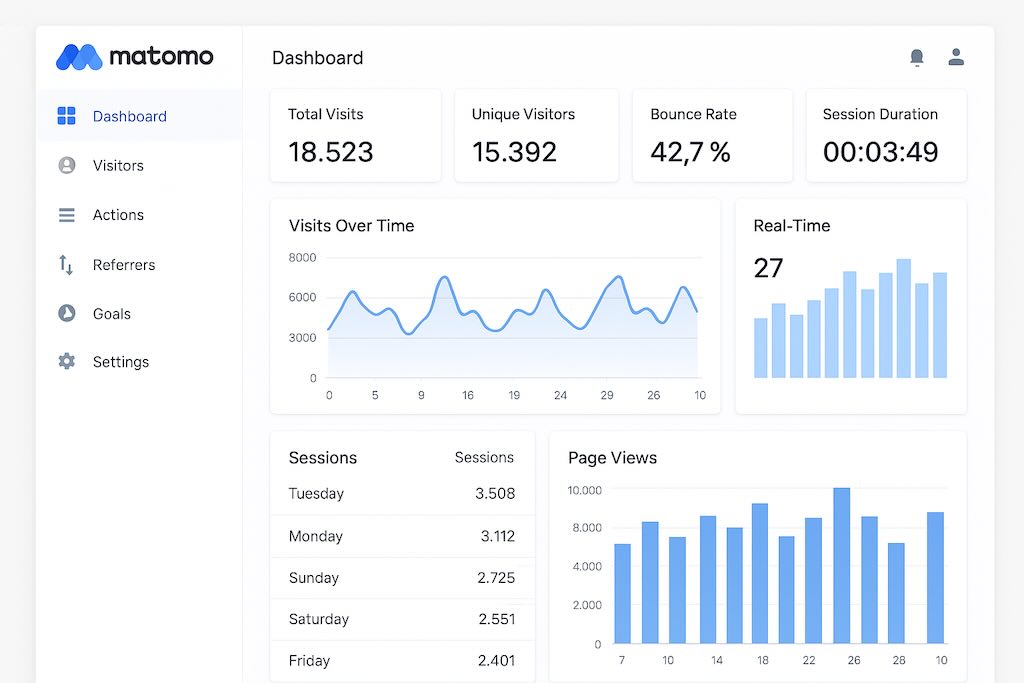
Matomo released version 5.4.0 on August 26, 2025, introducing a comprehensive interface redesign and strengthened privacy controls that position it as the leading privacy-first alternative to Google Analytics. The update delivers a cleaner dashboard design with refined icons, consistent tooltips, and streamlined navigation that significantly improves user experience while maintaining the platform’s commitment to data ownership and GDPR compliance.
This major release represents the most significant visual overhaul in Matomo’s recent history, addressing long-standing user feedback about interface complexity. With over 1 million websites now running Matomo — including the European Commission and major government agencies — the 5.4.0 update signals the platform’s maturation from a niche open-source project into an enterprise-grade analytics solution. Here is a detailed breakdown of every major change, how it compares to competitors, and whether migration from GA4 makes sense for your organization.
Redesigned Dashboard and Login Experience
The 5.4.0 release overhauls the Matomo login screen and main dashboard with a cleaner visual language. Refined icons, updated button styles, and consistent tooltips across the entire interface reduce visual clutter. The “Add New Measurable” modal now uses rich, descriptive cards instead of a plain dropdown, making it easier for new users to configure websites, mobile apps, or intranet properties without consulting documentation.
A new copy component allows administrators to duplicate reports, heatmaps, and other entities in one click — a feature enterprise teams requested for years. The top navigation bar received a complete icon refresh, and tooltip behavior is now standardized across all modules. These changes reduce onboarding time for non-technical stakeholders who previously found Matomo’s interface intimidating compared to simpler tools like Plausible or Fathom.
The design philosophy emphasizes clarity without sacrificing depth. Unlike Plausible’s deliberately minimal single-page dashboard — explored in depth in our comparison of Plausible, Umami, and GoatCounter for 2026 — Matomo retains hundreds of metrics and report types but now organizes them more intuitively. The result is a platform that can serve both a marketing manager checking traffic trends and a data engineer building custom dimension reports.
Enhanced Privacy and Security Controls
Security received substantial upgrades in this release. Superusers can now enforce strong password requirements across all accounts, applying industry-standard complexity rules organization-wide. Existing passwords that do not meet the new rules will continue to work until changed, preventing forced lockouts during rollout. Additional protections include restrictions on password reuse, automatic clearing of inactive password fields, inactivity notifications for superusers, and safer password reset messages that do not reveal whether an account exists.
Token authentication also improved. Users can now set custom expiry dates when creating personal auth tokens, and a scheduled task sends email notifications before tokens expire. This addresses a common enterprise pain point where stale API tokens posed security risks. Geolocation database downloads are now restricted to configured trusted hosts only, closing a potential data exfiltration vector that enterprise security auditors had flagged.
On the privacy front, Matomo continues to offer cookieless tracking mode, IP anonymization by default, and automatic Do Not Track signal respect. These features allow organizations in regulated industries — healthcare, finance, government — to run analytics without triggering cookie consent requirements under GDPR. As GDPR enforcement surpasses €5.88 billion in cumulative fines, this compliance-by-default approach becomes increasingly valuable.
Performance and Technical Improvements
The tracker code now uses sendBeacon by default when supported by the browser. This API sends analytics data asynchronously during page unload without delaying navigation, resulting in measurably faster perceived page load times. The change also improves data accuracy for single-page visits, where traditional XMLHttpRequest calls might be cancelled before completing.
The plugin architecture received modernization with improved Vue.js integration, replacing legacy Twig template systems with component-based development. For organizations with custom Matomo plugins, this means faster development cycles and better maintainability. The url_query_parameter_to_exclude_from_url setting was updated to automatically strip LinkedIn click IDs from page URL reports, and a bug where ChatGPT bot visits incorrectly appeared in campaign reports was fixed.
Notably, this release contains no major database schema upgrades, which means the update process is straightforward and does not require extended maintenance windows — a critical consideration for self-hosted deployments managing millions of daily pageviews.
Matomo Cloud vs Self-Hosted vs GA4 vs Plausible: Feature and Pricing Comparison
Choosing the right analytics platform depends on budget, technical resources, data sovereignty requirements, and feature needs. The following table compares four leading options across critical dimensions:
| Feature | Matomo Cloud | Matomo Self-Hosted | Google Analytics 4 | Plausible |
|---|---|---|---|---|
| Starting Price | $23/mo (50K hits) | Free (open-source) | Free (standard) | $9/mo (10K pageviews) |
| Data Ownership | You own data (EU-hosted) | Full ownership | Google retains access | You own data (EU-hosted) |
| Cookie Consent Required | Optional (cookieless mode) | Optional (cookieless mode) | Yes | No (no cookies used) |
| GDPR Compliant | Yes (data in Frankfurt) | Yes (your servers) | Requires configuration | Yes (EU-hosted) |
| Heatmaps & Session Recording | Yes (premium add-on) | Yes (premium add-on) | No (requires Hotjar etc.) | No |
| Custom Dimensions | Yes | Yes | Yes (limited to 50) | Limited (custom props) |
| Funnel Analysis | Yes (premium add-on) | Yes (premium add-on) | Yes | Yes |
| Script Size | ~22 KB | ~22 KB | ~45 KB | ~1 KB |
| Real-Time Reporting | Yes | Yes | Yes (limited) | Yes |
| Data Retention | Unlimited | Unlimited | 14 months (free) | Unlimited |
| Server Maintenance | None (managed) | Required (you manage) | None (managed) | None (managed) |
| GA Data Import | Yes | Yes | N/A | Yes |
| Open Source | Yes | Yes | No | Yes |
Matomo Cloud pricing scales to $16,900/month for 100 million monthly hits, with overage charged at €2.20 per 5,000 extra hits. Plausible scales more simply by pageview tiers. GA4 is free for standard use but GA4 360 for enterprises starts at approximately $50,000/year. For a deeper look at how alternative platforms stack up, see our analysis of Plausible’s team management capabilities and Fathom’s enterprise-focused features.
Migration Guide: Moving from GA4 to Matomo
Matomo provides a built-in Google Analytics importer that can transfer historical data directly. Here is a step-by-step migration framework:
Step 1: Install and configure Matomo. For self-hosted deployments, install on a server with PHP 8.1+ and MySQL/MariaDB. Cloud users can skip to step 2. Create a new “measurable” (website) in Matomo’s administration panel for the site you want to track.
Step 2: Import historical GA4 data. Use the GA Importer plugin’s “Quick Connect” option, which uses OAuth to pull reports directly from Google. Matomo recommends importing into a separate site property so you can set up live tracking in parallel. For large datasets, the import runs as a background process and can take several days.
Step 3: Deploy the Matomo tracking code. Replace gtag.js with the Matomo JavaScript tracker. For tag manager users, Matomo offers its own tag manager as an alternative to Google Tag Manager, or you can fire the Matomo tracker via GTM during a transition period.
Step 4: Migrate events and conversions. Replace all gtag('event', ...) calls with _paq.push(['trackEvent', category, action, name, value]). GA4 conversion events map to Matomo’s “Goals” system. Custom dimensions created in GA4 can be recreated manually or transferred automatically during data import.
Step 5: Validate and run in parallel. Run both GA4 and Matomo simultaneously for 2-4 weeks. Compare key metrics — sessions, pageviews, bounce rate, conversion counts — to identify tracking discrepancies before decommissioning GA4. Note that Matomo typically reports 5-15% higher traffic than GA4 because it can track visitors who block Google’s scripts or decline cookie consent.
Expert Perspective on Privacy-First Analytics
Matomo founder and Chief Product Officer Matthieu Aubry has consistently emphasized that privacy is an architectural decision, not a feature toggle. “You’ll gain more trust and greater loyalty with your customers when you prioritize privacy,” Aubry stated. “Your business will be better positioned to comply with new regulations, so you’ll avoid fines, and you’ll be better protected from data breaches.”
That philosophy shapes every release. The 5.4.0 update’s enforced password policies and token expiration features were built because enterprise security teams demanded them — not because a competitor shipped them first. As 78% of consumers now demand ethical data practices, Matomo’s privacy-by-design approach aligns with both regulatory trends and consumer expectations.
Independent research supports the case for privacy-first tools. Studies comparing GA4 data accuracy found that when cookie consent banners are displayed, GA4 fails to capture an average of 55.6% of website traffic compared to cookieless alternatives. For organizations where accurate visitor counts directly impact revenue decisions — publishers, e-commerce, SaaS — that gap represents a substantial blind spot.
Who Should Use Matomo — and When to Choose Alternatives
Choose Matomo Self-Hosted if your organization requires complete data sovereignty, operates under strict regulatory frameworks (GDPR, HIPAA, CCPA), or already maintains server infrastructure. Government agencies, healthcare providers, and financial institutions benefit most. The trade-off is ongoing server maintenance, security patching, and database optimization responsibility.
Choose Matomo Cloud if you want Matomo’s feature depth and privacy guarantees without managing infrastructure. At $23/month for 50,000 hits, it is cost-effective for small-to-mid-size businesses. Data is stored in Frankfurt, Germany, satisfying EU data residency requirements. Premium features like heatmaps and funnel analysis require separate subscriptions.
Choose Plausible if you prioritize simplicity and page speed above all else. Its 1 KB script is 75 times smaller than GA4’s, and the single-page dashboard requires zero training. Starting at $9/month, it suits blogs, personal sites, and teams that need traffic trends without deep segmentation. However, Plausible lacks session recording, heatmaps, and advanced e-commerce tracking.
Stick with GA4 if your workflow is deeply integrated with Google Ads, BigQuery, and Looker Studio, and your legal team is comfortable with Google’s data processing terms. GA4’s machine learning features for predictive audiences and churn probability have no direct equivalent in Matomo. For organizations already invested in the Google ecosystem, migration costs may outweigh privacy gains.
Matomo 5.4.0 does not try to be everything for everyone. It offers a credible middle ground: more features than Plausible and Fathom, more privacy than GA4, and more flexibility than any cloud-only platform. For the growing number of organizations where data ownership is non-negotiable, this release removes one of the last objections — that open-source analytics means tolerating a dated interface.