
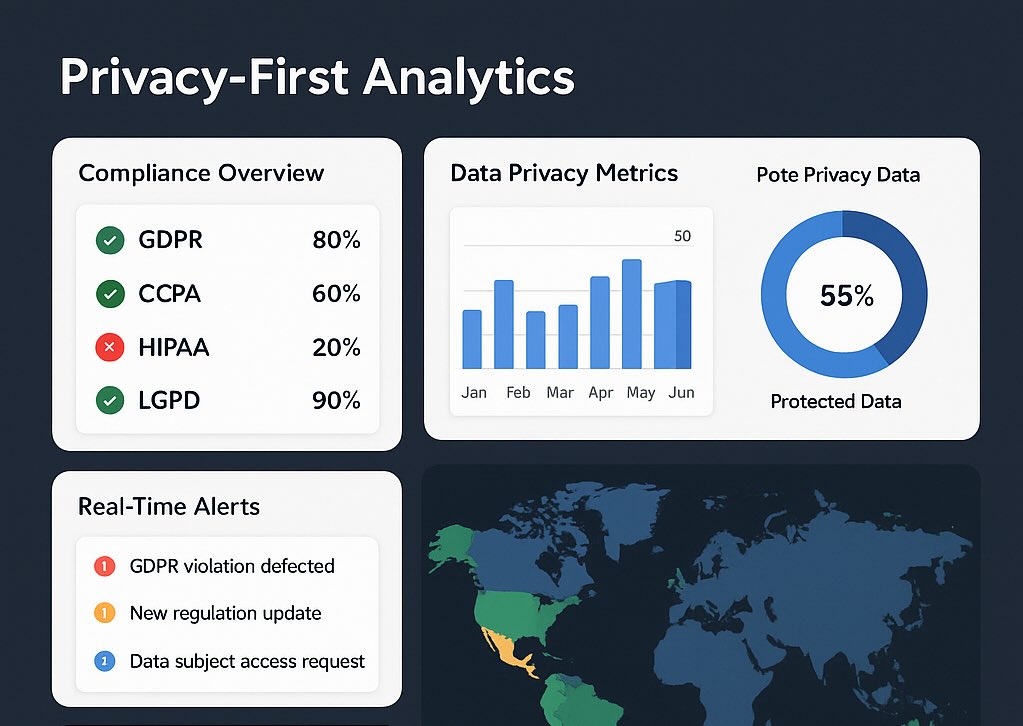
Consumer privacy concerns have reached a tipping point, with 78% of consumers now believing organizations have a responsibility to use artificial intelligence ethically, while 82% of internet users worldwide report high concern over personal data collection. This erosion of trust coincides with aggressive regulatory enforcement across 144 countries that have enacted data protection legislation, fundamentally altering the privacy-first analytics landscape and forcing businesses to adopt cookieless measurement approaches or face devastating financial penalties.
The convergence of consumer skepticism and regulatory pressure has created an unprecedented market shift. The global privacy-enhancing technologies market reached $3.12 billion in 2024 and is projected to hit $12.09 billion by 2030, growing at a 25.3% CAGR. Meanwhile, Cisco’s 2026 Data and Privacy Benchmark Study found that 99% of organizations report measurable benefits from privacy investments, with 90% expanding their privacy programs specifically because of AI adoption.
The 78% Consumer Demand: Source and Context
The 78% figure originates from comprehensive consumer surveys tracking attitudes toward ethical AI use across multiple global markets. However, this statistic sits within a broader pattern of eroding digital trust. Research from Relyance AI’s 2025 Consumer Trust Survey reveals that 82% of consumers view AI-driven data loss as a serious threat, and 76% would switch brands entirely for greater transparency.
Consumer behavior now directly reflects these attitudes. Approximately 75% of consumers refuse to purchase from companies they do not trust with personal data, while 48% have already stopped buying from a business due to privacy concerns. On the other side, consumers who trust a business to manage data responsibly are 23% more likely to make purchases. These numbers make privacy-first analytics not just an ethical obligation but a revenue imperative.
The Deloitte 2025 Connected Consumer study further quantifies the shift: 86% of consumers say transparency about data use matters more than it did five years ago, and 81% expect clear explanations before agreeing to data collection. Additionally, 84% of consumers familiar with generative AI advocate for mandatory labeling of AI-generated content. Privacy risks related to generative AI increased from 22% in 2025 to 34% in 2026, signaling accelerating concern.
Global Privacy Regulation Landscape
Regulatory enforcement has shifted from warnings to significant financial penalties worldwide. As of 2026, GDPR enforcement alone has reached €5.88 billion in cumulative fines, while new legislation continues rolling out across every continent. The following table summarizes the major privacy frameworks impacting analytics implementations globally.
| Regulation | Jurisdiction | Key Analytics Impact | Status (2026) |
|---|---|---|---|
| GDPR | EU/EEA | Consent required for cookies; fines up to 4% global revenue | Active, enforcement intensifying |
| CCPA/CPRA | California, US | Opt-out rights; automated decision-making rules by 2027 | Active, largest fine issued 2025 |
| LGPD | Brazil | GDPR-inspired; consent and legitimate interest basis | Active, enforcement expanding |
| DPDP Act | India | 72-hour breach notification; granular consent required | Phased rollout through 2027 |
| PIPA | South Korea | Strict cross-border transfer rules; AI profiling limits | Active, amended 2025 |
| PIPL | China | Data localization; separate consent for cross-border transfers | Active |
| Colorado AI Act | Colorado, US | Transparency for high-risk AI systems; algorithmic audits | Effective 2026 |
| 8 US State Laws | Various US states | Consumer opt-out; data minimization; protection assessments | Effective 2025-2026 |
European regulators have moved beyond tolerance of dark patterns in cookie consent. Sweden’s Data Protection Authority recently targeted major companies for manipulative banner designs that pressure users toward accepting tracking. The emphasis on “freely given, specific, informed, and unambiguous” consent has made traditional consent theater—prominent “Accept All” buttons with hidden reject options—legally untenable.
Google’s February 2025 policy update explicitly prohibits device fingerprinting and locally shared objects in GA4 and Firebase implementations, forcing businesses to find alternative identification methods. This shift reflects broader industry recognition that covert tracking methods violate both regulatory requirements and consumer expectations, a reality underscored by Google’s decision to abandon Privacy Sandbox.
Privacy-First Analytics Tools Compared
Organizations seeking privacy-compliant measurement have three leading alternatives to Google Analytics, each with distinct strengths. The choice depends on organizational size, compliance requirements, and technical resources.
| Feature | Matomo | Plausible | Fathom |
|---|---|---|---|
| Cookie Usage | Optional (cookieless mode available) | No cookies | No cookies |
| Script Size | 22.8 KB | ~1 KB | 1.6 KB |
| Self-Hosting | Yes (primary model) | Yes + cloud | Cloud only |
| GDPR Consent Required | No (in cookieless mode) | No | No |
| Compliance | GDPR, HIPAA, CCPA, LGPD, PECR | GDPR, CCPA, PECR | GDPR, CCPA, PECR |
| Certifications | — | — | SOC 2, ISO 27001 |
| Heatmaps/Session Recording | Yes | No | No |
| Best For | Enterprise, full GA replacement | Developers, SaaS, blogs | Regulated industries |
Matomo’s 5.4.0 release introduced a redesigned interface with enhanced privacy controls, positioning it as the most feature-complete GA4 alternative for enterprises that need session recording, heatmaps, and granular reporting. Meanwhile, Plausible’s team management features make it ideal for collaborative marketing teams seeking lightweight, open-source analytics. For organizations in regulated industries requiring independent audit certifications, Fathom’s SOC 2 and ISO 27001 credentials provide compliance documentation that Matomo and Plausible currently lack.
How to Build a Privacy-First Analytics Stack
Transitioning from surveillance-based analytics to a privacy-first measurement architecture requires systematic planning across four layers: data collection, processing, storage, and activation. Advanced privacy-preserving techniques—differential privacy, synthetic data generation, and on-device processing—are no longer experimental but essential business requirements.
The recommended implementation follows these steps:
- Audit current tracking: Identify all cookies, pixels, and fingerprinting mechanisms across your properties. Remove any covert tracking that violates Google’s updated policies or regional regulations.
- Implement server-side tracking: Move data collection server-side to gain greater control over third-party data sharing while reducing client-side vulnerabilities that trigger regulatory scrutiny.
- Deploy a consent management platform (CMP): Use a CMP that supports granular consent with one-click withdrawal, meeting both GDPR and emerging DPDP Act requirements.
- Select a privacy-first analytics tool: Replace or supplement GA4 with Matomo, Plausible, or Fathom based on your compliance needs and feature requirements (see comparison above).
- Adopt first-party data strategies: Build measurement around first-party data and aggregated cohort analysis rather than individual user tracking. Cryptographic techniques—homomorphic encryption, secure multi-party computation—now control 54% of the privacy-enhancing technology market.
- Establish data retention policies: Implement automated deletion workflows with proof of compliance, aligning with the 72-hour breach notification and deletion requirements emerging in India’s DPDP Act and similar frameworks.
As of 2026, 60% of large organizations have adopted privacy-enhancing computation to protect sensitive data while preserving analytical utility. Organizations that delay this transition face compounding compliance risk as eight new US state privacy laws took effect in 2025, with Indiana’s Consumer Data Protection Act following in January 2026.
The Business Case for Privacy-First Analytics
Privacy investment delivers measurable financial returns. According to Cisco’s 2026 Data and Privacy Benchmark Study—surveying over 5,200 IT and security professionals across 12 global markets—organizations earn up to $2.70 for every $1 spent on privacy programs. The study found that 96% of organizations report enhanced agility and innovation from appropriate data controls, 95% have built stronger customer trust, and 95% have achieved operational efficiencies through better data organization.
“Privacy has become integral to how organizations build trust, drive innovation, and stay competitive in the age of AI.”
— Harvey Jang, Vice President and Chief Privacy Officer, Cisco
The investment trajectory confirms this trend. In 2026, 38% of organizations spend $5 million or more annually on privacy programs, up sharply from just 14% the previous year. Furthermore, 43% report increased privacy spending over the past 12 months, and 93% plan to allocate more resources to privacy and data governance over the next two years.
Consumer trust translates directly to revenue. Sixty percent of consumers indicate they would spend more with brands they trust to protect their data. Conversely, 75% refuse to purchase from untrusted companies. For digital marketing teams, this creates a clear ROI argument: privacy-first analytics infrastructure costs less than the combined risk of regulatory fines, customer churn from privacy breaches, and lost revenue from distrust.
AI Governance Expands Privacy Programs
The intersection of AI and privacy has created new organizational demands. IAPP’s 2025-2026 research shows that 68% of privacy professionals now handle AI governance alongside traditional compliance work, while 99% expect to reallocate resources from privacy budgets to AI initiatives. Colorado’s AI Act, effective in 2026, establishes obligations for developers and deployers of high-risk AI systems to prevent algorithmic discrimination and provide transparency—directly affecting analytics platforms that use machine learning for attribution and audience segmentation.
Research reveals that 57% of global consumers view AI’s use in collecting and processing personal data as a significant privacy threat. Meanwhile, 81% of those familiar with AI believe it will lead to personal information being used in ways they find uncomfortable. Organizations relying on AI-driven analytics must now provide transparent explanations of how their models reach conclusions and what data feeds those models.
The privacy-first analytics transformation represents more than regulatory compliance. It signals a fundamental shift toward sustainable business models built on user trust rather than surveillance-based data extraction. Organizations that embrace this transition—deploying privacy-enhancing computation, selecting compliant analytics platforms, and investing in transparent data governance—position themselves for competitive advantage as the global data privacy software market grows from $5.37 billion in 2025 toward a projected $45.13 billion by 2034.