
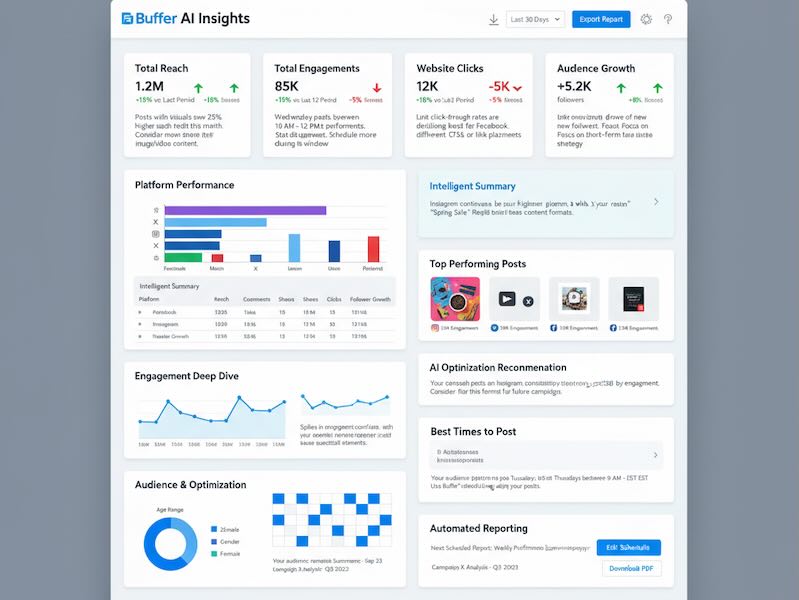
Buffer has transformed its analytics platform with AI-powered insights that automatically identify content performance patterns, optimal posting strategies, and audience engagement trends without requiring manual data analysis. The enhanced Buffer Analyze system provides intelligent recommendations for posting frequency, content types, and timing optimization based on individual brand performance rather than generic best practices. This evolution addresses the complexity of multi-platform social media management by consolidating Instagram, Facebook, Twitter, and LinkedIn analytics into unified, actionable intelligence—similar to how Hotjar and Contentsquare merged their analytics platforms.
How Buffer’s AI Assistant Changes Content Strategy
Buffer’s AI Assistant, built on advanced language models, goes beyond simple text generation. The tool analyzes engagement history across connected social channels to recommend content formats, tones, and structures most likely to resonate with each brand’s specific audience. A single long-form post can be repurposed into platform-specific variations for LinkedIn, Threads, X, Instagram, and Bluesky with one click—adjusting length, hashtag density, and call-to-action placement for each network’s algorithm preferences.
The AI-driven platform analyzes engagement rates, reach metrics, and conversion data to generate personalized content strategies that adapt to changing audience behaviors and platform algorithm updates. Integration with boosted post tracking enables comprehensive comparison between organic and paid content performance, providing complete visibility into social media ROI across all marketing channels. Buffer’s social media analytics now include Instagram Stories metrics, cross-platform reporting, and automated trend detection that alerts users to significant performance changes.
Unlike standalone AI writing tools, Buffer’s assistant is embedded directly into the publishing workflow. Marketers draft, optimize, and schedule from a single dashboard rather than copying text between applications. The AI is included in every plan—including the free tier—so access is not gated behind enterprise pricing. This approach mirrors the broader industry shift toward embedded AI in creative tools, where automation sits inside existing workflows rather than requiring separate platforms.
Key Social Media Metrics Buffer Tracks
Buffer Analyze provides granular data across five metric categories that form the backbone of any social media reporting framework. Understanding what each metric reveals—and what it does not—is essential for translating dashboard numbers into strategic decisions.
Engagement metrics include likes, comments, shares, saves, and click-through rates. Buffer calculates an aggregate engagement rate per post and compares it against the account’s historical average, flagging posts that significantly outperform or underperform. Reach and impressions data shows how many unique users saw a post versus the total number of times it appeared in feeds, helping marketers distinguish between viral amplification and repeated exposure to existing followers.
Follower growth tracking plots net new followers over time and correlates spikes or drops with specific posts or campaigns. Audience demographics—age, gender, location, and active hours—feed directly into the AI’s posting-time recommendations. Finally, content-type performance breakdowns compare how videos, carousels, static images, and text-only posts perform on each connected channel, giving marketers clear signals about where to invest production effort.
Buffer vs Hootsuite vs Sprout Social vs Later: Feature and Pricing Comparison
Choosing the right social media management platform depends on team size, budget, and the depth of analytics required. The table below compares the four most frequently evaluated platforms across pricing, AI capabilities, and analytics depth.
| Feature | Buffer | Hootsuite | Sprout Social | Later |
|---|---|---|---|---|
| Starting Price | Free; $6/mo per channel | $99/mo (5 accounts) | $249/mo per user | Free; $25/mo (Starter) |
| AI Content Creation | Built-in AI Assistant (all plans) | OwlyWriter AI (paid plans) | AI Assist with Suggestions | AI caption generator |
| Analytics Depth | Per-post and channel-level; audience demographics | Advanced with custom reports; social listening add-on | Enterprise-grade; cross-channel; competitive analysis | Instagram-focused; basic multi-channel |
| Supported Platforms | 8 (incl. Bluesky, Threads) | 10+ | 10+ | 7 (Instagram-centric) |
| Best For | Solopreneurs, small teams | Mid-size marketing teams | Agencies, enterprises | Visual-first brands, Instagram |
| Social Listening | No | Add-on ($49+/mo) | Included (Standard+) | No |
| White-Label Reports | Team plan ($12/ch/mo) | Business plan ($739/mo) | Professional plan ($399/mo) | No |
| Free Trial | 14 days (paid plans) | 30 days | 30 days | 14 days |
Buffer’s per-channel pricing model makes it the most affordable option for users managing one to three social accounts. However, costs scale quickly for larger operations: managing 10 channels on the Team plan reaches $120 per month, at which point Hootsuite’s flat-rate Professional plan becomes competitive. Sprout Social’s per-user pricing positions it firmly in the enterprise segment, but its built-in social listening and competitive analysis tools eliminate the need for third-party monitoring subscriptions that other platforms require.
Who Should Use Buffer—and When to Choose an Alternative
Buffer is strongest for freelancers, solo marketers, and small businesses that need scheduling and basic analytics without enterprise complexity. Its clean interface, generous free tier, and included AI assistant make it an effective entry point for teams publishing across three to five social channels. The platform is also well-suited for content creators who prioritize consistent posting cadence over deep audience research.
Teams that require social listening, sentiment analysis, or competitive benchmarking should look at Sprout Social or Hootsuite, both of which offer these features natively. Agencies managing 20 or more client accounts may find Buffer’s per-channel pricing unsustainable compared to Hootsuite’s or Sprout Social’s tiered plans. Similarly, brands that depend heavily on Instagram Reels and visual content planning may prefer Later’s drag-and-drop visual calendar and media library, which are more specialized than Buffer’s general-purpose interface.
The analytics gap is the most important differentiator. Buffer reports on owned-channel performance—posts, followers, engagement on your own accounts. It does not track competitor activity, brand mentions across the web, or industry-wide trend data. For organizations where privacy-first analytics and ethical data collection are priorities, Buffer’s straightforward metrics approach avoids the surveillance-heavy social listening models used by larger platforms.
Integration Capabilities and Workflow Automation
Buffer connects with over 30 third-party services through direct integrations and Zapier workflows. Native integrations include Canva for in-app image creation, Dropbox and Google Drive for media library sync, and Shopify for e-commerce product promotion. The Zapier connection extends Buffer’s reach to CRM platforms, email marketing tools, and project management systems—allowing teams to trigger social posts from events in HubSpot, Mailchimp, or Asana without leaving those tools.
API access on Team and Agency plans enables custom integrations for organizations with specific data pipeline requirements. Analytics data can be exported as CSV or pulled via API into business intelligence platforms like Looker, Tableau, or Google Data Studio for combined reporting alongside website analytics from tools like Fathom Analytics or Plausible. This is particularly valuable for marketing teams that need a unified view of social performance alongside web traffic and conversion data.
Buffer’s browser extension and mobile app support on-the-go scheduling, while the link-in-bio tool (Start Page) provides a lightweight landing page that consolidates social traffic into a single trackable URL—useful for Instagram and TikTok profiles where link options are limited.
The Broader Shift Toward AI-Driven Social Analytics
Buffer’s evolution reflects an industry-wide pattern: social media tools are shifting from passive dashboards to active advisory systems. Joel Gascoigne, Buffer’s co-founder and CEO, has noted that the company “had better data in the first 2-3 years of the company when we were using improvised solutions than with our sophisticated business intelligence platform.” That insight drove Buffer’s move toward analytics that surface recommendations rather than simply displaying charts.
The competitive pressure is real. Hootsuite launched OwlyWriter AI to generate post drafts from trending topics. Sprout Social integrated AI Assist for sentiment classification and response suggestions. Later added AI-powered caption generation and hashtag recommendations. Each platform is racing to reduce the time between data collection and strategic action, a pattern also visible in how ChatGPT’s growing market share is reshaping how users discover and interact with content online.
For marketers evaluating their analytics stack, the key question is no longer whether a platform offers AI features—nearly all do. The differentiator is how well those features integrate into daily workflows and whether the insights they generate are specific enough to act on immediately. Buffer’s strength is simplicity: fewer features, but each one tightly connected to the publishing and reporting cycle. For teams that need depth over breadth, Sprout Social and Hootsuite remain the more comprehensive options, particularly for organizations managing paid social campaigns alongside organic content, as tracked through tools like ChatGPT’s evolving citation patterns.
Professional reporting capabilities have expanded to include white-label options for agencies managing multiple client accounts, with automated report generation and custom dashboard creation tools. The platform’s machine learning algorithms continuously refine recommendations based on performance data, ensuring strategies remain optimized as audience preferences and platform dynamics evolve.