
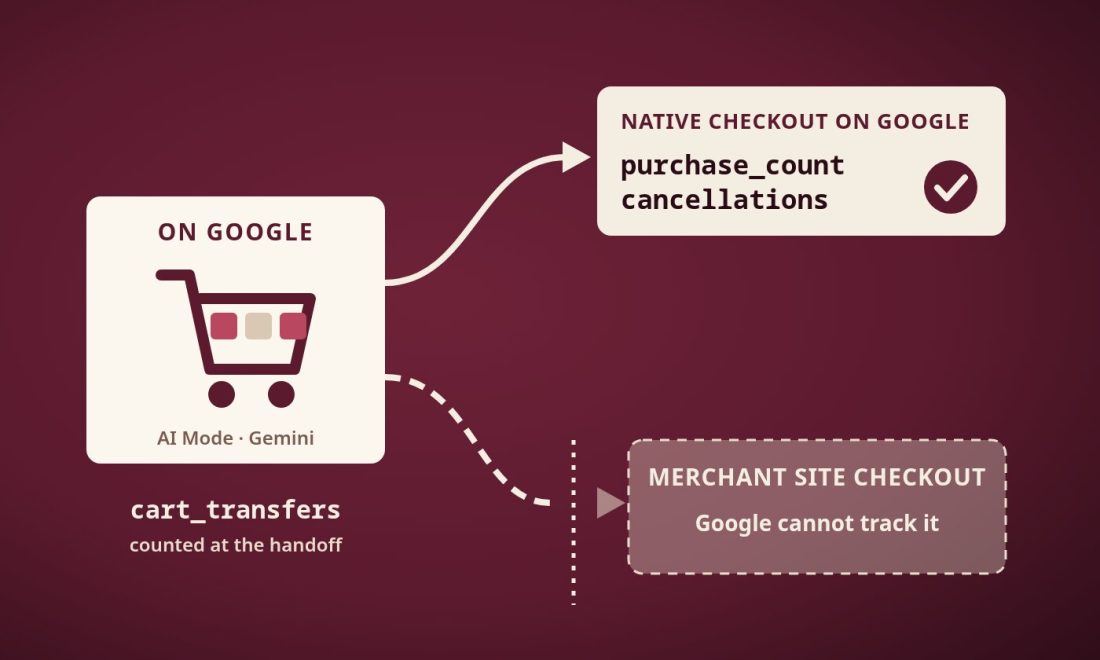
Google’s documentation now answers the question we left open on October 8: in its Universal Commerce Protocol (UCP) reporting, a cart transfer is not counted as a purchase. One of the two new UCP performance reports in the Merchant API, both in alpha, counts cart transfers as its own metric, and the rewritten Merchant Center analytics page says that once a cart reaches the merchant’s site, “Google cannot track any further activity.” The sale after the handoff is yours to measure.
Does Google count a UCP cart transfer as a purchase?
Not under Google’s definitions. The API defines purchase_count as “fully completed purchases performed directly from Google” and counts cart_transfers separately, as times a user “transfers the cart to checkout on the merchant’s website.” The analytics page adds: “After the cart has been transferred to your site for checkout, Google cannot track any further activity.”
What changed since the September version of the page?
Our report on the UCP integration hub and its unanswered cart-transfer question cited Google’s analytics documentation page. Its September version promised visibility “from initial click to completed purchase” and listed a Purchase Rate, the percentage of Clicks to Buy that ended in a purchase. A Wayback capture from September 21 preserves that version, which also said the data was “not available using the Merchant API yet.”
The current page, last updated October 27, splits the checkout funnel in two. “Native checkout on Google” is where the entire purchase happens on Google, so the report tracks purchases and cancellations there. “Transfer to merchant cart” covers carts sent to your site. The page no longer lists a Purchase Rate. We can speak only for the documentation; we have not seen the dashboard itself.
What do the new UCP performance reports cover?
The Merchant API release notes for October 2026 add two v1alpha views to accounts.reports.search, covering UCP checkout and conversion metrics “across Google surfaces, including AI Mode in Search and Gemini.” Search Engine Roundtable dates the release to October 26; Google’s notes say only “October 2026.” UcpAgenticPerformanceView is the account-level funnel, segmented by date and customer country. UcpAgenticProductPerformanceView reports buy button clicks per offer ID. UCP checkout itself is still limited: Google’s Merchant Center help page says merchants are notified once selected, and onboarding is rolling out gradually in the U.S., with Australia and Canada to follow next year.
The table below lists nine of UcpAgenticPerformanceView’s metrics with the wording from the reports_v1alpha reference and whether the September page had a counterpart.
| Metric | Type | Google’s API definition | On the September page? |
|---|---|---|---|
| buy_button_clicks | Non-price | “Number of buy button clicks performed directly from Google.” | Yes (Clicks to Buy) |
| accounts_linked | Non-price | “Number of times a customer successfully linked their Google account to their merchant account.” | Partly (Account Linking, “where applicable”) |
| account_linking_rate | Non-price | “Percentage of times a customer successfully linked their Google account to their merchant account.” | Partly (success rates mentioned) |
| purchase_count | Non-price | “Number of fully completed purchases performed directly from Google.” | Yes, then defined as “successful transactions completed using UCP” |
| purchase_value | Price | “Value of fully completed purchases performed directly from Google.” | No |
| average_order_value | Price | “Average amount spent on a single order, excluding cancellations and refunds.” | Yes (AOV) |
| cancellations | Non-price | “Number of times either a merchant or a customer cancelled an order.” | Yes, then defined as orders “canceled or refunded after purchase” |
| cart_transfers | Non-price | “Number of times a user transfers the cart to checkout on the merchant’s website.” | No |
| average_cart_value | Price | “Average value of the cart at the time of transfer to merchant’s website.” | No |
How do you query the views without breaking the totals?
Google’s guide to analyzing UCP agentic performance marks the feature as alpha: “subject to change.” Queries use Merchant Center Query Language (MCQL). Four points from the guide and the reference decide whether the numbers add up:
- Every query needs a condition on date in the WHERE clause, for both views.
- Keep funnel metrics such as buy_button_clicks out of any query with Price metrics. Mixing them splits rows by currency and can omit rows without purchase values.
- On an advanced account, leave out account_id to aggregate metrics across all sub-accounts. Select it and you get a row per sub-account.
- The product view returns buy button clicks only. Its description says “for example, purchases,” but no purchase field is listed.
Google’s first sample query, the currency-independent one, looks like this:
SELECT date, account_id, customer_country_code,
  buy_button_clicks, accounts_linked, account_linking_rate,
  purchase_count, cancellations, average_purchase_product_count,
  cart_transfers, average_cart_product_count
FROM ucp_agentic_performance_view
WHERE date = '2026-09-20'
What is left for the merchant to measure?
Google counts the handoff, and average_cart_value describes the cart “at the time of transfer.” What happens at checkout on your site is outside its report, by its own statement. Treat purchase_count and purchase_value as native checkout, cart_transfers as the top of your own funnel, and reconcile the rest against backend orders.
The API has no purchase-rate metric, so any rate you compute needs a denominator you define first. Neither the API reference nor the analytics page says whether buy button clicks include cart-path clicks.
Some definitions don’t line up yet. In the API reference, account_linking_rate is a “percentage of times” with no stated base. The analytics page describes average cart value as excluding cancellations and refunds, while the API defines it “at the time of transfer.” The page calls cart transfers the “number of clicks to transfer the cart”; the API says “number of times a user transfers the cart.” We quote these and leave them unresolved. For the earlier thread on what Merchant Center’s AI reporting does and doesn’t count, see where no metric is a click.