
Merchant Center’s AI performance insights report just grew three new sections, and two of them read like instructions rather than data: add these words to your product descriptions, add these missing attributes to your products. As reported by Search Engine Roundtable on September 9, 2026, the additions were spotted in Brodie Clark’s screenshots of the interface, and Google updated the report’s own help document the same day. Read that document and one thing stands out: nothing under either instruction is a click.
What Are the Three New Sections in Merchant Center’s AI Report?
In Search Engine Roundtable’s account of the update, the interface now shows three additions. AI Search Intent is presented as a way to see how products match customer AI searches. AI Search Terms is presented as a way to improve visibility by including popular terms in product descriptions. AI Attributes is presented as a way to increase visibility by adding missing attributes to products. Search Engine Roundtable credits the find to Brodie Clark’s screenshots of the interface, seen here only through Search Engine Roundtable’s write-up of them. The wider report, AI performance insights, launched in July 2026 and began expanding to additional regions in early September, per the same coverage.
What Does Merchant Center’s AI Performance Report Count?
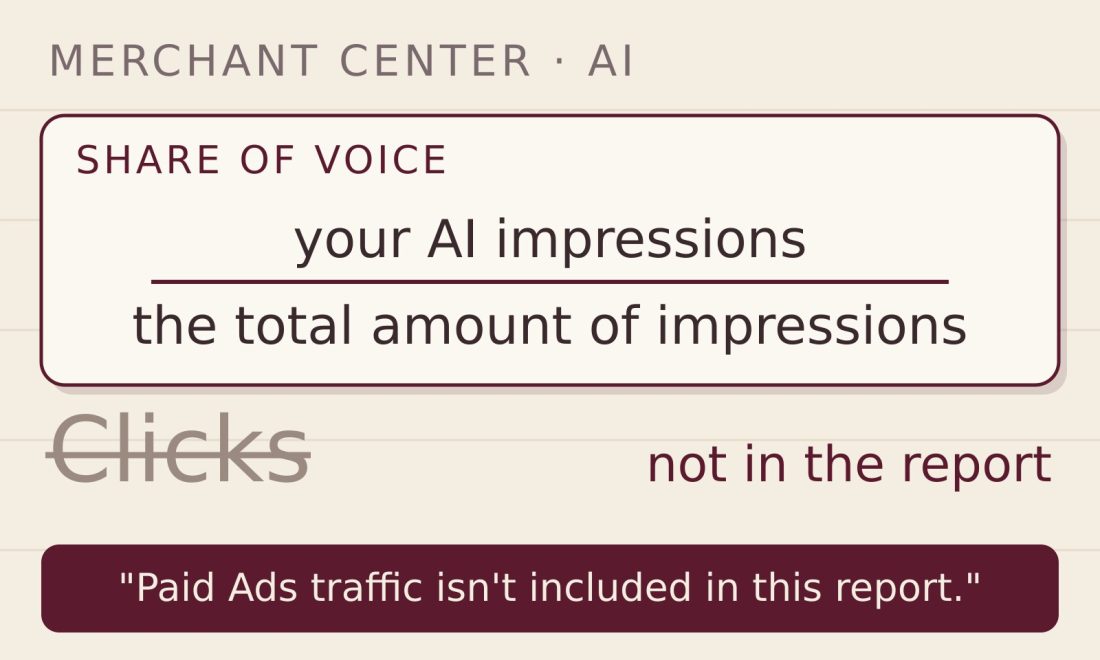
The figures Google documents for this report include impressions, ratios of impressions, a frequency measure, and a count of how many of a merchant’s products are showing in each of the three sections. Share of voice is defined in Google’s help document as reflecting “your number of AI impressions divided by the total amount of impressions,” with a companion figure reported for a merchant’s defined competitor set. The same document states that “Current data is strictly limited to organic AI traffic (for example, free listings)” and that “Paid Ads traffic isn’t included in this report.” No sentence in the document mentions a click, a session, or a revenue figure.
Why Do the Interface and the Documentation Disagree on the Names?
Google’s help document groups these three items under a heading called “Actionable trends,” and names them differently than the interface does. The document calls them Top terms (“Highlights search terms within a product category that shoppers are actively prioritizing”), Popular attributes (“Provides structured technical specifications customers look for”), and Top search intents (“Understand the context behind conversational queries”). None of those three phrases, “AI Search Intent,” “AI Search Terms,” or “AI Attributes,” appears in the document itself.
| Named in the interface (via Search Engine Roundtable) | Named in the help document, under “Actionable trends” | What each label describes or instructs |
|---|---|---|
| AI Search Terms | Top terms | Interface: add these words to product descriptions. Document: describes terms shoppers are prioritizing. |
| AI Attributes | Popular attributes | Interface: add missing attributes. Document: lists specifications customers look for. |
| AI Search Intent | Top search intents | Interface: see how products match AI searches. Document: explains context behind conversational queries. |
Two Google surfaces are describing the same three sections in different words, on the day the documentation itself was updated to match the interface. Neither source says one name replaced the other, and neither says Google renamed anything. It is a mismatch between two Google surfaces, dated to the same day, nothing more asserted than that.
What Does the Documentation Leave Unsaid?
The document does not define what counts as one AI impression, not per answer, not per product tile, not per surface. It does not say who sits in the denominator of share of voice either: the text gives “the total amount of impressions” for the brand figure and “your defined Merchant Center competitor set” for the benchmark figure, without saying whether the two totals are the same set, the wider product category, or something else. It gives no methodology for how a query gets sorted into the shopping stages it names, Discovery, Evaluation, and Ready to Buy, or into one intent rather than another.
On timing, the document is specific about one thing and silent about another. It says “Historical data is available and updated on a daily basis with a few days lag,” without a number attached to the lag itself. And it bounds availability by language and market: “Currently available for English-language queries for Merchant Center accounts in Australia, Canada, India, New Zealand, and the United States.” AI performance insights itself is not new: it was announced May 27, 2026 alongside a separate capability called Conversational Attributes.
What Should a Merchant Do With Two New Instructions and No Click to Check Them Against?
Two things follow directly from what the document does and does not say. Share of voice is an internal indicator of visibility on Google’s own AI surfaces, not a channel metric comparable to anything measured outside Merchant Center, since the same company that owns the surfaces being counted also computes the ratio. And the vocabulary itself is unstable: the screenshots relayed by Search Engine Roundtable read “AI Search Terms,” while the document underneath reads “Top terms,” so recording which name a screenshot used is worth doing while the two vocabularies differ.
The instructions themselves, add these terms, add these attributes, are the newer problem. Google does write impression definitions down elsewhere. Its move to begin-to-render impressions for display ads sets out exactly when the count happens, in Ad Manager and AdSense, a different part of the business from Merchant Center. Merchant Center’s AI report offers no equivalent definition for its own impression. Before adding a missing attribute or a popular term because a section instructs it, check whether that change is measurable in anything the merchant already owns, because this report will not say whether it worked. Nothing in it counts a click, before or after.
Merchant Center is not the only place a number sourced from Google stands in for visibility on AI surfaces. Ahrefs’ AI adjusted volume is built by taking Google’s search volume figure and multiplying it by a platform-specific ratio, a vendor estimate that also begins with a Google number rather than a direct count of AI queries.
Sources: Google Merchant Center Help; Search Engine Roundtable.