
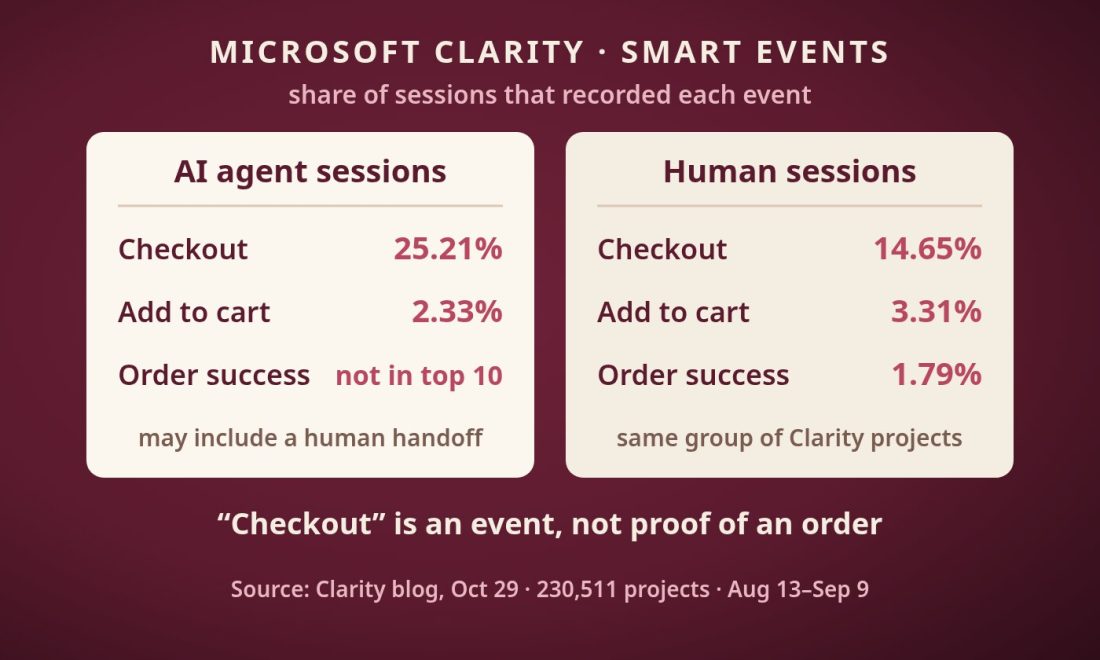
Microsoft Clarity published a study on October 29 of sessions it classifies as agentic, covering 230,511 Clarity projects. Checkout was recorded in 25.21% of those AI agent sessions, against 14.65% of human sessions in the same cohort of projects. Clarity also says its Agent Activity Dashboard is now generally available for projects with agentic traffic.
What did Microsoft Clarity find about AI agent sessions?
Clarity analyzed “over 5.2 million distinct agentic-classified sessions across 230,511 Microsoft Clarity projects from August 13–September 9, 2026 (UTC)”, identified through detected agentic browser providers in the OpenAI, Google and Anthropic ecosystems. Checkout was the most common recorded action, followed by Submit form (19.85%) and Outbound click (14.28%). Clarity adds that an agentic session “may also include a human handoff”, so the numbers describe activity during sessions involving agents, not necessarily tasks an agent finished on its own.
How do agent and human sessions compare?
Clarity published a top ten for each group. Where an event appears in only one list, the other group’s share must sit below that list’s tenth place, and no exact figure is given.
| Smart Event | % of agentic sessions | % of human sessions |
|---|---|---|
| Checkout | 25.21% | 14.65% |
| Submit form | 19.85% | 18.56% |
| Outbound click | 14.28% | 26.99% |
| Search | 7.16% | 4.79% |
| Login | 6.83% | 8.84% |
| Show more | 4.31% | 6.37% |
| Add to cart | 2.33% | 3.31% |
| Download | 1.69% | 2.97% |
| Order success | below 1.69%, not published | 1.79% |
| Begin checkout | below 1.69%, not published | 1.62% |
| Book appointment | 8.42% | below 1.62%, not published |
| Check availability | 2.41% | below 1.62%, not published |
Clarity’s own summary is that “the clearest difference, then, isn’t that agentic sessions perform a completely different set of actions. It’s how heavily those actions are weighted.”
Does “Checkout” mean a purchase?
The post does not define the event. It says Smart Events capture “business-critical actions such as checkouts, form submissions, appointment bookings”, without saying whether Checkout fires on a click, a page view or a finished order.
The human column gives a clue. Checkout is recorded in 14.65% of human sessions and Order success in 1.79%, so, by our calculation, Checkout appears about eight times as often as Order success. In the agentic list, Checkout (25.21%) is roughly 10.8 times Add to cart (2.33%), again by our calculation. Clarity warns that these events “should not be interpreted as steps in a single conversion funnel or proof that an agent independently completed a task.” Read Checkout as an event, not as revenue.
Can Clarity tell the agent from the person?
Not inside a session. In Clarity’s words, it “cannot currently separate the agent and human portions into different sessions”. A session that includes a handoff mixes what the agent did with what the person did, and the study’s counts can blend the two.
That mirrors a problem we covered in Google’s UCP reports, where measurement stops at an agent handoff. It is also a different question from the one in the GA4 studies of AI-referred conversion rates. Those count people who click through from AI answers. Clarity’s study counts sessions in which agents browse the site.
What base do the percentages use?
By our calculation, the percentages rest on about 1.22 million sessions, not the 5.2 million in the post’s headline. Dividing session counts by shares gives the same base on every row, within rounding: 306,621 / 0.2521 is about 1,216,000, and 28,289 / 0.0233 is about 1,214,000. PPC Land reached the same figure. The post does not explain the gap. It also says Checkout accounted for 25.21% of agentic “actions”, while the table footnotes define the shares as sessions with an action divided by all agentic sessions.
What is the Agent Activity Dashboard?
Clarity says it is “now generally available for projects with agentic traffic” and helps businesses “identify agentic traffic and understand how AI agents interact with their websites”. For ecommerce and travel and hospitality sites, it mentions that simulations can help find improvements; the post does not explain what they do. The post also says agentic-session volume rose 88% in three weeks, without naming the weeks or the starting volume.
What should teams using Clarity do with this?
Agent sessions already show up in Clarity’s data, so a session label is only the first step. Check how your own Smart Events are defined before comparing Checkout across groups. Set it beside Order success, or better, beside the orders in your own system. Until a conversion survives that comparison, treat a Checkout in an agent session as an event recorded during that session, not a sale.