
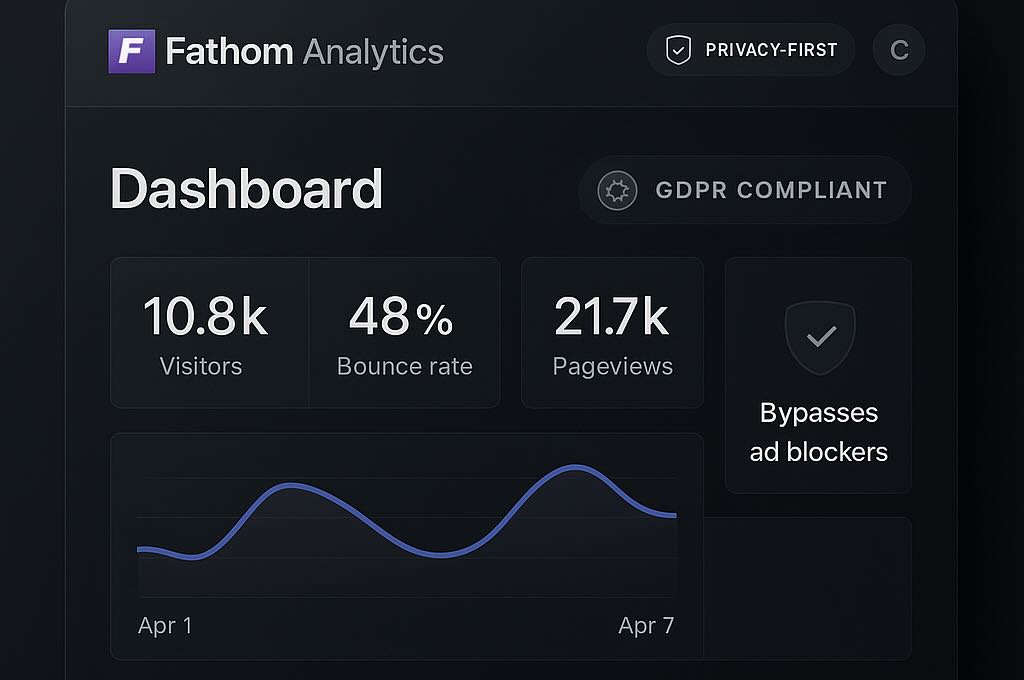
Fathom Analytics has carved out a distinctive position in the privacy-first analytics market by solving a problem that plagues every web analytics platform: ad blockers. With approximately 32.5% of internet users running ad-blocking software globally — a figure expected to push past 1 billion active users by 2026 — businesses relying on traditional analytics tools face a growing blind spot in their traffic data. Fathom’s custom domain bypass, combined with expanding enterprise capabilities, makes it a compelling option for organizations that refuse to choose between privacy compliance and data completeness.
How Fathom’s Ad Blocker Bypass Actually Works
Most ad blockers operate by maintaining blocklists of known tracking domains. When a browser encounters a script request to a domain on that list — such as Google Analytics’ googletagmanager.com or even Plausible’s default script URL — the request gets silently dropped. The result: analytics platforms never register the visit, and site owners see artificially deflated traffic numbers.
Fathom takes a fundamentally different technical approach. Instead of serving its tracking script from a recognizable third-party domain, Fathom allows customers to create a custom subdomain that points to Fathom’s infrastructure via a DNS CNAME record. When a visitor’s browser loads the page, the tracking script appears to come from the same domain as the website itself. Since ad blockers cannot universally block first-party scripts without breaking most of the web, the analytics data passes through unimpeded.
The implementation is straightforward. Site owners create a subdomain (e.g., stats.yourdomain.com), add a DNS record pointing it to Fathom’s servers, and update their embed code. Both the subdomain name and the generated script filename are randomized, preventing ad blocker maintainers from targeting predictable URL patterns. Fathom’s script itself weighs under 2 KB — roughly 14 times smaller than Matomo’s 20 KB tracking code — minimizing any performance impact.
The critical distinction here is that Fathom achieves this bypass without compromising visitor privacy. The platform collects no personally identifiable information (PII), uses no cookies, and stores no data that could be used to track individuals across sites. This is not a surveillance workaround; it is a technical solution to ensure legitimate, privacy-respecting analytics are not collateral damage of ad-blocking tools designed to stop invasive trackers.
Enterprise Features Breakdown
When Fathom launched in 2018, co-founded by Paul Jarvis and Jack Ellis, it was deliberately minimal — a single-page dashboard showing pageviews, referrers, and top pages. The platform has since evolved substantially while maintaining that core simplicity. Here is what the current feature set includes for business and enterprise users:
Custom Event Tracking. Fathom supports tracking specific user actions including button clicks, form submissions, file downloads, and ecommerce transactions with revenue attribution. Events can be configured through JavaScript calls or HTML data attributes without touching server-side code.
API Access. The Fathom API provides full programmatic control over account entities and supports ad-hoc custom report generation. Server-side tracking is also available, enabling analytics collection from backend systems where client-side JavaScript is not practical.
Multi-Site Management. Every Fathom plan includes support for up to 50 websites under a single account at no additional cost, making it particularly attractive for agencies and multi-brand organizations.
Team Collaboration and Reporting. Shared dashboards, email reports, and CSV export capabilities allow teams to distribute analytics access without sharing login credentials. This is especially useful for agencies presenting data to clients.
Infrastructure Scalability. Fathom runs on serverless infrastructure backed by an enterprise-grade database, designed to scale indefinitely for high-traffic websites and web applications without performance degradation.
As Jack Ellis, Fathom’s co-founder and CTO, has stated: “The way we run our business is ridiculously simple: we charge a fair amount of money for our product, use that money to keep the business running indefinitely, and remain small so that we don’t need a lot of money to be profitable and sustainable.” That philosophy extends to the product itself — no freemium tier, no data monetization, no venture capital pressure to extract more from users.
Pricing Analysis: What Fathom Costs in Practice
Fathom uses a single-axis pricing model based entirely on monthly pageviews. There are no feature gates — every customer gets the full platform including custom domains, event tracking, API access, and multi-site support. The pricing tiers break down as follows:
| Monthly Pageviews | Price (Monthly) | Cost per 100K Pageviews |
|---|---|---|
| 100,000 | $15 | $15.00 |
| 200,000 | $25 | $12.50 |
| 500,000 | $50 | $10.00 |
| 1,000,000 | $80 | $8.00 |
| 5,000,000 | $140 | $2.80 |
| 10,000,000 | $200 | $2.00 |
| 25,000,000 | $470 | $1.88 |
A few notable aspects of this model. First, there are no contracts — customers can cancel anytime and export all their data. Second, Fathom offers a 7-day free trial before requiring payment. Third, the per-pageview cost drops significantly at higher tiers, from $15 per 100K at the entry level down to $1.88 per 100K at the 25 million tier. For sites exceeding two consecutive months above their tier, Fathom will suggest an upgrade; similarly, customers consistently under their tier can downgrade from billing settings.
Compared to Google Analytics 4, which is free for standard use but costs $50,000+/year for GA360 with enterprise features, Fathom occupies a middle ground. It is more expensive than free GA4 but dramatically cheaper than GA360, while offering something neither Google tier provides: complete ad blocker bypass and genuine privacy compliance without cookie banners.
Fathom vs Plausible vs Matomo vs GA4: Head-to-Head Comparison
The privacy-first analytics market has matured significantly, with each major platform carving out a distinct niche. For a detailed look at the open-source side of this market, see our head-to-head comparison of Plausible, Umami, and GoatCounter. The following comparison covers the key decision factors for teams evaluating their options:
| Feature | Fathom | Plausible | Matomo | GA4 |
|---|---|---|---|---|
| Hosting | Cloud only (SaaS) | Cloud or self-hosted | Cloud or self-hosted | Cloud only (Google) |
| Starting Price | $15/mo (100K views) | $9/mo (10K views) | Free (self-hosted) / $24/mo (cloud) | Free / $50K+/yr (GA360) |
| Ad Blocker Bypass | Yes (custom domain) | Proxy option (manual) | Self-hosted bypasses | No |
| Cookies Required | No | No | Optional (cookieless mode) | Yes |
| Cookie Banner Needed | No | No | Depends on config | Yes (in EU) |
| GDPR Compliant | Yes, by default | Yes, by default | Yes (with config) | Disputed / requires consent |
| CCPA Compliant | Yes | Yes | Yes | Requires configuration |
| Data Ownership | Fathom (Canadian servers) | EU-hosted / your servers | Your servers (self-hosted) | |
| Script Size | <2 KB | <1 KB | ~20 KB | ~45 KB |
| Open Source | No (Lite version archived) | Yes (AGPL) | Yes (GPL) | No |
| Event Tracking | Yes | Yes (goals + custom props) | Yes (advanced) | Yes (advanced) |
| Ecommerce Tracking | Basic (revenue events) | Revenue attribution | Full ecommerce suite | Full ecommerce suite |
| Session Recordings | No | No | Yes (premium plugin) | No (separate product) |
| Funnels | No | Yes (Business plan) | Yes | Yes |
| Multi-Site (included) | Up to 50 | 1–10 (varies by plan) | Unlimited (self-hosted) | Unlimited properties |
The comparison reveals clear positioning differences. GA4 offers the deepest feature set but at the cost of privacy concerns, cookie requirements, and zero ad-blocker resistance. Matomo provides the most comprehensive self-hosted solution with enterprise analytics features like heatmaps and session recordings, but its tracking script is significantly heavier and configuration complexity is higher. Plausible excels in lightweight simplicity and open-source transparency, with EU-hosted infrastructure that appeals to European businesses, but its ad-blocker bypass requires manual proxy configuration.
Fathom’s differentiator remains the built-in ad blocker bypass combined with full privacy compliance — a combination no competitor matches out of the box.
GDPR, CCPA, and Global Privacy Compliance
Privacy compliance is not an add-on feature for Fathom; it is the architectural foundation. The platform was built from the ground up to operate without collecting any personally identifiable information. No IP addresses are stored. No cookies are set. No fingerprinting techniques are employed. This means Fathom requires no cookie consent banners under GDPR, no opt-in mechanisms under CCPA, and no special configuration for PECR (the UK’s Privacy and Electronic Communications Regulations).
With GDPR enforcement fines reaching the €5.88 billion milestone and regulators increasingly scrutinizing analytics implementations, the compliance advantage is quantifiable. Organizations using GA4 in the EU must implement proper consent management platforms, handle data subject access requests for analytics data, and navigate the ongoing legal uncertainty around EU-US data transfers. Fathom sidesteps all of these requirements because it simply does not collect the data that triggers them.
For businesses operating across multiple jurisdictions — particularly those serving both EU and US audiences — Fathom eliminates an entire category of compliance overhead. No Data Protection Impact Assessments for analytics. No Standard Contractual Clauses for cross-border data transfers. No analytics-related entries in Records of Processing Activities. The growing consumer demand for ethical data practices, now at 78%, makes this positioning increasingly relevant from both a legal and brand perspective.
Who Should Use Fathom — and When to Choose Alternatives
Fathom is the strongest choice for organizations in the following situations:
- Content publishers and SaaS companies where accurate traffic counts directly affect business decisions, ad revenue, or investor reporting — and where ad blocker usage among their technical audience may exceed 40%.
- Agencies managing multiple client sites that need clean, presentable dashboards without the complexity of GA4’s interface. The 50-site limit per account and email reporting make client management efficient.
- EU-focused businesses that want to eliminate cookie banner requirements for analytics entirely, reducing both legal risk and the conversion impact of consent popups.
- Teams that value simplicity and need pageviews, referrers, top pages, UTM tracking, and basic event tracking — without the months-long learning curve of GA4’s data model.
However, Fathom is not the right tool for every situation. Choose Matomo if you need advanced behavioral analytics like heatmaps, session recordings, A/B testing, or full ecommerce funnel analysis. Choose Plausible if open-source licensing, EU data sovereignty with self-hosting, or a sub-$15/month entry price is a priority. Choose GA4 if you need deep integration with Google Ads, advanced attribution modeling, or BigQuery export for complex data science workflows — and your consent management infrastructure is already in place.
Fathom occupies a specific and defensible niche: maximum data accuracy through ad blocker bypass, genuine privacy compliance without configuration, and a clean interface that requires no training. For the growing number of businesses that consider analytics data integrity and privacy compliance equally non-negotiable, that combination is difficult to replicate with any other single tool.