
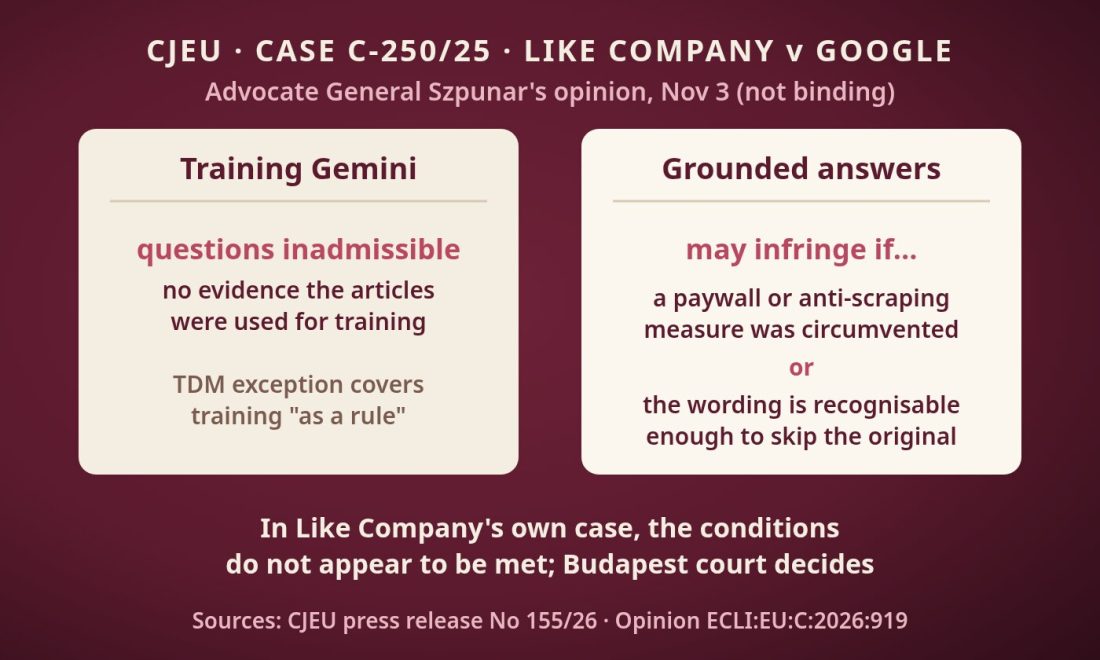
Advocate General Maciej Szpunar did not say that Gemini infringes press publishers’ rights. In his opinion in Case C-250/25, delivered on 3 November and summarised in the Court’s press release, he proposes a test for when a chatbot’s answer can infringe, and he reads Like Company’s own facts as falling short of it, subject to the Budapest court’s findings. The opinion is not binding on the Court of Justice.
What did the Advocate General say in Like Company v Google?
Advocate General Maciej Szpunar’s opinion in Case C-250/25, delivered on 3 November, advises the Court of Justice to declare the two training questions inadmissible as hypothetical and to focus on Gemini’s answers. In his view, real-time retrieval and reuse of press articles by AI chatbots may, in certain circumstances, infringe publishers’ rights. It is a non-binding opinion, not a ruling.
Like Company, a Hungarian operator of web portals, sued Google Ireland before the Budapest Regional Court. It relies on the press publishers’ right in Article 15(1) of the 2019 copyright directive and says Google used its articles to train Gemini and reproduced them through the chatbot between 13 June 2023 and 31 May 2024. The Court’s press release calls it the first generative AI case to reach the Court of Justice. The full text is on EUR-Lex.
| Question referred | AG’s proposed answer |
|---|---|
| Q1. Answers: communication to the public | Answered together with question 4: making available occurs if the form of expression is “systematically recognisable, to the extent described above, in the answers provided by the chatbot to related user queries” |
| Q2. Training: reproduction | Inadmissible (hypothetical) |
| Q3. Training: TDM exception | Inadmissible (hypothetical) |
| Q4. Answers: reproduction | Answered together with question 1: reproduction occurs if either of two conditions is met (below); the acts count as the provider’s only if inherent to its business model or it lacked appropriate measures |
On training, the opinion gives two reasons: there is no evidence Like Company’s articles were used to train Gemini, and training is not “online use” of press publications. “For the sake of completeness”, the Court’s press release says, he suggests that training on protected works is “as a rule, freely permitted under the text and data mining exception”.
When can a chatbot’s answer infringe?
The proposed answer to the first and fourth questions, which the Advocate General examines together, says reproduction occurs if the chatbot “has accessed that publication unlawfully, in particular by circumventing effective technical measures designed to restrict access to, or the scraping of, that publication; or” the form of expression is “recognisable in the answer provided to the user by the chatbot, to such an extent that the user, by reading that answer, can dispense with accessing the original publication entirely.”
The two are joined by “or”, so either can be enough. Facts are not protected: in the opinion’s words, the right grants “exclusivity over the form of expression” in the articles, “not the facts reported therein”. So being retrieved is not enough; what matters is whether access controls were circumvented or whether the answer stands in for the article.
Is leaving pages open the same as consent?
Not in the Advocate General’s view. Google argued that a publisher who leaves articles freely accessible, with no paywall and no measures against scraping bots, should be regarded as having implicitly consented to their reuse for grounding. The Advocate General answered: “I do not think that is the case.”
His reasoning is practical. A paywall “is a significant commercial choice”, and anti-scraping measures, it appears, “do not always adequately distinguish” why a bot visits. “In the case of Google, it seems that the same bots serve both functions”, so blocking them “may affect the display of the website concerned in search engines”, as Like Company told the hearing. Our piece on the controls publishers have over Google’s uses of their content covers the same trade-off for search.
Google told the Court that using the Google-Extended protocol to block training and grounding would not affect a website’s visibility on Google. The Advocate General: “That would need to be verified.” Even if so, findings of implicit consent “seem far-fetched” at this early stage.
Who is liable for the answer?
Under the Advocate General’s proposed answer, the chatbot provider, in two cases: where the acts “are inherent to that provider’s business model”, or where it “has failed to put in place the appropriate measures that can be expected from a reasonably diligent operator in its situation in order credibly and effectively to counter” them.
What does the opinion not settle?
On Like Company’s own facts, the Advocate General says it “would appear” the conditions are not met, subject to the referring court. Like Company did not put in place effective technological measures, it is not apparent that its example answer recognisably reproduces the article’s form of expression, the acts do not appear inherent to Google’s business model, and Google “seems to have put in place appropriate measures”.
Open points:
- Which measures count. The opinion names a paywall and measures designed specifically to prevent bot access or scraping. The opinion does not say whether a robots.txt rule qualifies as an “effective technical measure”.
- Other services. The opinion mentions AI Overviews and AI Mode only as comparable services; the questions and proposed answers are framed around LLM-powered online chatbots, and the dispute is about the Gemini chatbot.
- Other exceptions. The Advocate General leaves aside whether the exceptions for current-events reporting or quotation could apply.
Circumvention fights over scraping are already in court in the US. Google’s amended complaint against SerpApi, which we covered earlier, rests on DMCA §1201. That is a US anti-circumvention law, a different law from the EU press publishers’ right, and the two should not be read as one test.
What happens next?
The judges are beginning their deliberations and the judgment will be given at a later date. The Court is not bound by the opinion. It then answers the Budapest court’s questions, and that court decides the dispute itself.