
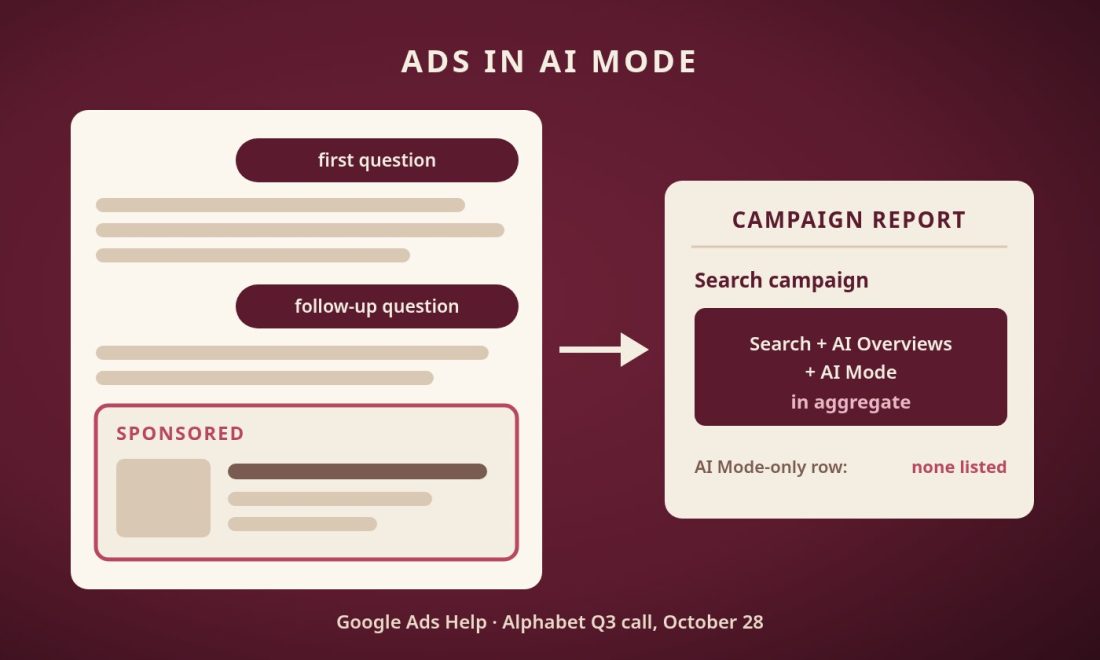
On October 28 Google said it is bringing ads in AI Mode to ten more countries and launching multiturn ads in the U.S., so ads can appear on follow-up questions. For advertisers in the new markets, the practical detail sits on a help page: nothing new to set up, no opt-out separate from Search, and the results arrive “in aggregate.”
Which countries get ads in AI Mode, and what is multiturn?
Google’s announcement names Australia, Canada, India, Kenya, Malaysia, New Zealand, Nigeria, Pakistan, the Philippines and Singapore. It adds that “in Q4 2026, we plan to expand to additional locales, including Brazil, Mexico, and the United Kingdom.” Those three are plans, not live markets.
Multiturn ads are the U.S. launch. Google says they let ads run “in follow-up queries in AI Mode,” labeled “Sponsored.” The post names no other country for them.
The help page adds caveats the blog post leaves out. The Google Ads Help page lists Pakistan as “text ads only” and Indonesia as AI Overviews only. The blog post carries neither caveat, and Indonesia is not in its list. The help page also says its location list may not be exhaustive and that the language is English.
Can advertisers opt out of ads in AI Mode?
No, not separately from Search. The help page says you can’t target ads exclusively to AI Overviews or AI Mode, or opt out of showing ads in them separately from Search. Existing Search, Shopping and Performance Max campaigns are “automatically eligible,” with no new campaigns or budgets needed. What you can keep using are negative keywords and brand exclusions to control when and how ads serve, and you aren’t charged extra to participate.
What does the help page say about matching and reporting?
Ads can match the query directly or, in Google’s words, “contextually to both the user’s query and the AI response.” The help page sets these rules:
- AI Max, broad match, Shopping and Performance Max are eligible for both kinds of matching.
- Exact and phrase match keywords are eligible when a query expresses direct commercial intent, but “aren’t eligible for contextual matching on broader exploratory questions.”
- The AI explainers that appear with some ads are “concise, independent text generated by Google’s Gemini models,” and advertisers “can’t manually write, edit, approve, or opt out of them.”
On measurement, the page says performance metrics for these ads “are included in aggregate in your standard Google Ads campaign reports,” and the same applies to the search terms report. It names no report, segment or column that isolates AI Mode. That is what the page says today, and it is not a claim about what Google will or won’t add. Search Console has a similar gap: its AI report shows only impressions, as we covered in our piece on AI Mode links in Search Console.
With no AI Mode segment named on the page, the search terms report is where to look. Google says AI Mode queries are “on average, three times longer than traditional searches,” citing a U.S. report from May 2026, so unusually long, conversational terms are a reasonable place to start. That is our inference, not something Google documents as a method, and the page does not say whether AI Mode queries appear there as separate terms.
What did Google say about CTR and monetization?
Google’s CTR evidence is narrow. The blog says click-through rates are “already similar between sponsored and organic product list items within AI Mode,” citing internal U.S. data from August 20 to September 3, 2026. That covers product list items in one country over two weeks. It says nothing about text ads, other markets, conversion rates or CPCs.
On the same day’s earnings call, JP Morgan’s Douglas Anmuth asked why query growth at its fastest in five years came with slower Search growth. Philipp Schindler, Google’s chief business officer, named FX as “the single largest driver of Search deceleration relative to Q2” and vertical-specific dynamics as another, then said “the strong growth in AI Mode queries had an impact because of the lower monetization we were seeing in AI Mode.” He added: “To be clear, we feel very good about our trajectory here.” The official transcript gives no figure for the gap, and neither do we. He also said Search grew 12% year-over-year to $63 billion in Q3.
What should advertisers in the new markets check?
Your campaigns may already be serving in AI Mode, and the help page names no breakdown that would show how much. Compare search terms for new long-form queries, watch conversions on campaigns that take broad match or AI Max, and note that Google’s AI explainers can appear beside your ad, and you can’t write, edit, approve or opt out of them. For the text Google generates inside Search ads themselves, see our report on AI review summaries that advertisers cannot edit.