
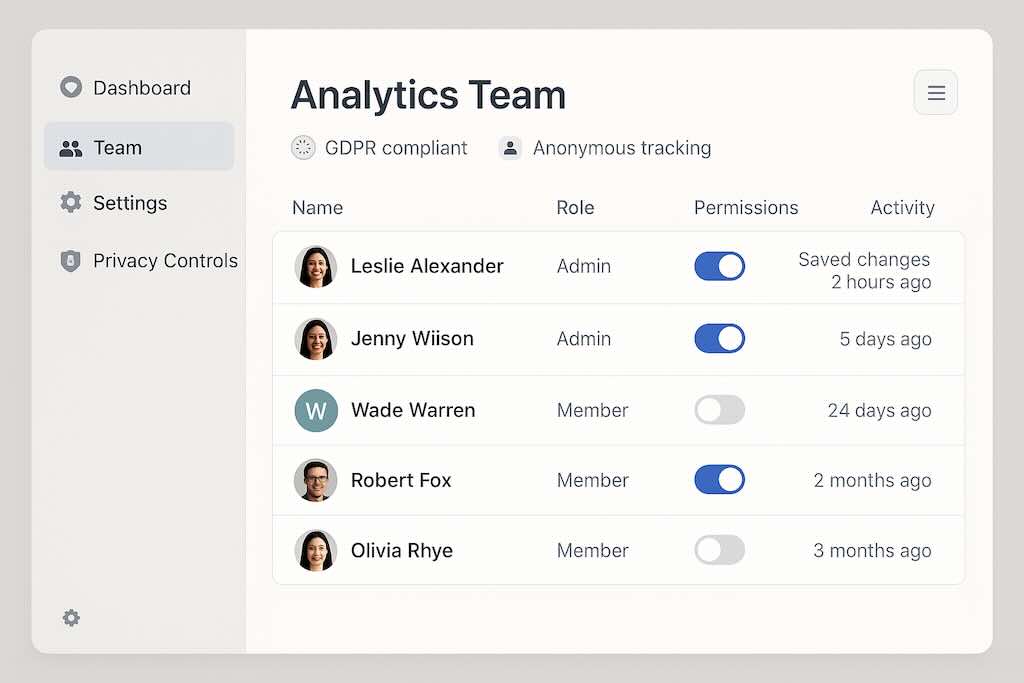
Plausible Analytics has launched comprehensive team management capabilities that address one of the biggest pain points for businesses using privacy-first analytics platforms. The new “Create a Team” feature allows organizations to add multiple owners and billing contacts, eliminating the risk of losing access when key personnel leave the company. With role-based permissions, mandatory two-factor authentication, and SAML 2.0 single sign-on support, the update positions Plausible as a serious contender for enterprise adoption in the growing privacy-first analytics market.
How Plausible Team Management Works
The team management system introduces a structured hierarchy that replaces the previous single-owner account model. Organizations can now designate multiple owners with full administrative control, including billing management and the ability to add or remove sites. Team members receive tiered access levels, from view-only permissions for stakeholders who need dashboard access to editor roles for marketing teams managing goals and funnels.
Bulk operations significantly reduce administrative overhead. Administrators can invite multiple team members to a site simultaneously, or add a single team member to several sites in one action. This is particularly valuable for agencies managing client accounts, where onboarding a new analyst previously required repetitive manual invitations across dozens of properties.
Security controls have received equal attention. Team owners can enforce mandatory two-factor authentication (2FA) for all members through the Team Settings panel. Organizations on eligible plans gain access to Single Sign-On (SSO) via SAML 2.0, supporting identity providers including Google, Okta, and Microsoft Entra. Site ownership transfers between Plausible accounts are also now supported, addressing a long-standing request from businesses undergoing mergers or personnel changes.
Plausible Pricing Tiers and Team Limits
Plausible uses a pageview-based pricing model across four tiers, with team member limits varying by plan. All plans include core analytics features, cookie-free tracking, and GDPR compliance. The key differentiator between tiers is team size, site count, and access to advanced marketing features.
The following table breaks down Plausible’s current pricing structure at the 10k and 1M monthly pageview levels:
| Plan | Price (10k pageviews) | Price (1M pageviews) | Team Members | Sites | Key Features |
|---|---|---|---|---|---|
| Starter | $9/mo | $69/mo | 1 | 1 | Core analytics, goals, UTM tracking |
| Growth | $14/mo | $104/mo | 3 | 3 | Team access, sharing, API access |
| Business | $19/mo | $139/mo | 10 | 10+ | Funnels, custom properties, ecommerce |
| Enterprise | Custom pricing | Custom | Custom | SSO, priority support, SLA | |
Annual billing provides the equivalent of two free months. Organizations exceeding 10 million monthly pageviews, or needing more than 10 sites and 10 team members, must contact Plausible for custom Enterprise pricing. There are no long-term contracts on any tier, and teams can upgrade or downgrade as traffic fluctuates.
Plausible vs Fathom vs Matomo: Team Features and Pricing Compared
The privacy-first analytics market now offers three mature platforms with distinct approaches to team collaboration, pricing, and deployment. This comparison covers the factors most relevant to organizations evaluating their options in 2026, a trend accelerated by the broader surge in privacy-first analytics adoption.
| Feature | Plausible | Fathom | Matomo |
|---|---|---|---|
| Starting Price | $9/mo (10k pageviews) | $15/mo (100k pageviews) | $26/mo (50k hits) or free self-hosted |
| Team Members (entry plan) | 1 (Starter) | Unlimited | Unlimited (self-hosted) |
| Role-Based Access | Yes (owner, editor, viewer) | Yes (manager, viewer) | Yes (granular per-site permissions) |
| SSO / SAML | Enterprise plan | Not available | Available (plugin) |
| Mandatory 2FA | Yes (team-wide) | Per-user only | Yes (enforceable) |
| Self-Hosted Option | Yes (Community Edition) | No | Yes (free, full-featured) |
| Script Size | <1 KB | ~1.6 KB | ~22.8 KB |
| Cookies Required | No | No | Optional (configurable) |
| Funnels | Business plan | Yes (all plans) | Yes (premium feature) |
| Heatmaps | No | No | Yes (premium feature) |
| Data Hosting | EU (Germany) | EU & US options | Your choice (self-hosted) or EU (cloud) |
Plausible offers the lowest entry price but restricts team members on lower tiers. Fathom’s recent enterprise expansion includes unlimited team members across all plans, making it attractive for larger teams on a budget. Matomo 5.4’s redesigned interface remains the most feature-rich option, particularly for organizations requiring heatmaps, A/B testing, and granular user-level analytics, though its script size is roughly 22 times larger than Plausible’s.
Technical Architecture: Why the Script Stays Under 1 KB
Plausible’s tracking script weighs less than 1 KB, making it 75 times smaller than Google Analytics and 22 times smaller than Matomo’s default script. This is not a stripped-down compromise. The engineering team uses a Handlebars template system with conditional compilation, generating 1,024 different script variants from a single codebase of roughly 30 lines of build logic. Each variant includes only the features a specific site needs, eliminating dead code.
The backend runs on Elixir with the Phoenix framework, chosen for its ability to handle high-concurrency workloads with minimal resource consumption. Application data sits in PostgreSQL, while analytics queries run against ClickHouse, a columnar database optimized for aggregating billions of events with sub-second response times. This architecture allows Plausible to process analytics data in real time without the batch processing delays common in legacy platforms.
Cookie-free tracking relies on a daily rotating hash of the visitor’s IP address, User-Agent string, and the website domain. This hash cannot be used to identify individuals across days, sites, or devices. No persistent identifiers are generated, no data is written to the visitor’s browser, and raw IP addresses are never stored in the database. The approach means Plausible captures overall traffic trends rather than individual user journeys.
GDPR Compliance Without Consent Banners
Plausible’s cookie-free, identifier-free architecture has a direct business impact: organizations using it can potentially eliminate analytics-related consent banners entirely. Research cited by Plausible indicates that consent banners cause approximately 55% data loss, as visitors either reject tracking or leave the site. By removing the need for consent prompts, businesses recover a more complete picture of their traffic.
Steffen Gross, a data protection lawyer at Simpliant Legal PartG mbB, has provided a legal assessment supporting Plausible’s position. His analysis concludes that Plausible’s implementation can operate in compliance with both the GDPR and the ePrivacy Directive without requiring prior user consent, since no personal data is processed and no information is stored on or read from the user’s device.
However, the legal landscape is not entirely settled. Some privacy professionals argue that the ePrivacy Directive’s requirements around accessing device information may still apply regardless of anonymization. Organizations operating in jurisdictions with strict interpretations of the ePrivacy rules should consult their own legal counsel. What is clear is that Plausible’s approach substantially reduces compliance burden compared to cookie-based analytics platforms, a factor driving adoption amid GDPR enforcement that has now reached €5.88 billion in cumulative fines.
Advanced Analytics Capabilities Beyond Team Management
The team management update arrived alongside several analytics enhancements that challenge the assumption that privacy-first tools sacrifice depth for simplicity. Plausible’s improved “Time on Page” tracking now uses engagement signals rather than page transition measurements. This method captures data from visitors who bounce after reading a single page and excludes time spent on inactive tabs, producing more accurate engagement metrics than traditional approaches.
The Top Channels Report automatically categorizes traffic into marketing channels including Direct, Organic Search, Referral, Paid Social, and Email. Combined with “does not contain” filters and multiple entry segmentation, these features enable the kind of audience analysis that previously required Google Analytics or enterprise tools. The addition of Looker Studio integration and comprehensive CSV export capabilities ensures Plausible data flows into existing business intelligence workflows.
Plausible also now supports custom properties (available on Business plans), allowing teams to attach metadata to pageviews and events. An ecommerce site can track product categories, pricing tiers, or checkout steps without writing custom JavaScript. Goal funnels visualize drop-off points in multi-step processes, providing conversion optimization data that was previously missing from privacy-first platforms.
Who Should Consider Plausible in 2026
Plausible fits a specific profile. Organizations that need aggregate traffic insights without individual user tracking, that operate in the EU or serve EU audiences, and that value page load performance will find it compelling. The sub-1 KB script makes it particularly suitable for content publishers, SaaS landing pages, and mobile-first sites where every kilobyte affects Core Web Vitals scores.
Agencies managing multiple client sites benefit from the Growth and Business tier bulk operations, though the 3-member limit on Growth plans may push mid-sized teams toward Business pricing sooner than expected. The self-hosted Community Edition remains available for organizations that require full data sovereignty, running on standard Docker infrastructure with the same Elixir/ClickHouse stack as the cloud version.
Teams that need individual user tracking, session recordings, heatmaps, or A/B testing should look at Matomo or dedicated product analytics tools instead. Plausible intentionally does not offer these features, as they would require the kind of data collection that conflicts with its privacy-first architecture. For organizations that have already moved beyond Google’s shifting privacy strategy, Plausible’s team management update removes one of the last barriers to adopting it as a primary analytics platform.