
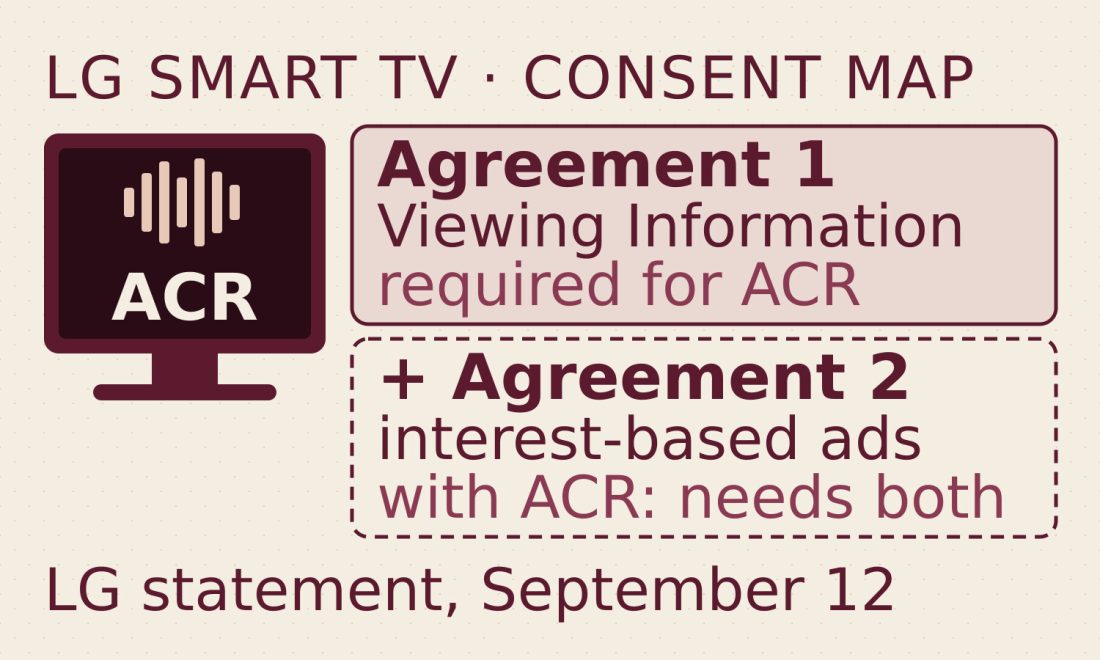
LG’s newsroom published “Understanding Privacy on LG Smart TVs” on September 12, dateline Seoul, answering the smart-TV investigation Gamers Nexus and others published earlier in September. Read as a document, not a denial, it works like a consent map: each row names an agreement or leaves it unnamed. LG’s own sentences require one agreement to enable ACR and both agreements before LG uses ACR for interest-based advertising; for audience segmentation and trend analysis of ACR-related information, they name no second agreement.
What Does LG’s Viewing Information Agreement Enable?
Per LG’s September 12 statement, accepting the Viewing Information Agreement is required to enable ACR. Where ACR is available and enabled, ACR-related information may be used for audience segmentation and viewing or audience trend analysis. Interest-based and cross-device advertising need a separate agreement, and some voice commands may also require the Viewing Information Agreement.
Eight Rows, Read Against LG’s Own Sentences
LG’s statement never uses the phrase “consent map,” but it functions like one. In the table, text in quotation marks is LG’s; the rest is our reading:
| Use or Processing | What LG’s Statement Requires | Agreement Named |
|---|---|---|
| Turning on ACR | “a user must accept LG’s Viewing Information Agreement, which describes how ACR works” | Viewing Information Agreement |
| ACR-related information that may be used for “audience segmentation and viewing or audience trend analysis” | “Where ACR is available and enabled” | None named beyond ACR being enabled |
| ACR-related viewing information that may be shared with LG Ad Solutions for segmentation and trend analysis | “Depending on the market, applicable agreements, and user choices”; “where separately consented to” attaches only to interest-based and cross-device advertising | Not named for segmentation or trend analysis |
| Interest-based advertising built on ACR | “LG does not use ACR for interest-based advertising unless a user opts in to both agreements” | Viewing Information Agreement + Interest-Based Cross Device Advertising Agreement |
| “HDMI-connected device information” for “audience segmentation or other advertising-related purposes” | “only when the user has separately accepted the applicable advertising-related agreements” | “Applicable advertising-related agreements” (undefined) |
| Nearby Wi-Fi access-point and signal-strength information that may be used to help estimate approximate location “in support of ACR services” | “In markets where ACR is available and enabled”; “only when the relevant agreements have been accepted” | Not named |
| Certain voice commands (e.g., which content source is active) | Viewing Information Agreement “may also be required” | Viewing Information Agreement (conditional) |
| Do Not Sell request or withdrawal of consent | “ACR data collection stops” | Not applicable, opt-out |
Three rows carry no named agreement: ACR-related information that may be used for segmentation and trend analysis, its possible sharing with LG Ad Solutions for those purposes, and the Wi-Fi-based location estimate. They hinge on ACR being “available and enabled,” on “applicable agreements,” or on unspecified “relevant agreements.”
Two Phrases, Two Different Conditions
LG requires separately accepted advertising-related agreements for two uses: interest-based and cross-device advertising, and “HDMI-connected device information” used for “audience segmentation or other advertising-related purposes.” Whether “ACR-related information” from an HDMI source and “HDMI-connected device information” name the same data, the text never says: for ACR-related information that “may be used for audience segmentation and viewing or audience trend analysis,” the statement names no agreement beyond the one required to enable ACR; HDMI-connected device information may be used for audience segmentation “only when the user has separately accepted the applicable advertising-related agreements.” That is not a contradiction, since the two are never tied together, but it is a gap the statement leaves open.
The Questions a Segment Buyer Should Ask
Nielsen’s own ratings currency already folds in viewing data from automatic content recognition systems built into smart TVs. LG’s statement names no agreement for segmentation of ACR-related information beyond the one required to enable ACR, while noting that, “in certain markets and under applicable user agreements,” ACR-related information “may also be shared in ways that may be considered a ‘sale’ or ‘sharing’ of personal information under applicable privacy laws.” That leaves questions for anyone evaluating an ACR-based segment, not claims about any vendor:
- Which agreement does a given segment rest on: the viewing agreement alone, or an advertising agreement too?
- Does it include HDMI-sourced viewing, and under which named condition?
- What happens to supply once a “Do Not Sell” request stops ACR collection?
Australia’s exposure draft shows how one draft law treats segment targeting and bundled consent: its consultation paper counts targeting an individual “as part of a broader audience, segment, or cohort” as direct marketing. The draft is not in force, and nothing here assesses LG’s agreements against it.
LG’s Earlier Response, the Texas Settlement and the Critics
LG’s September 12 statement was not its first word. Days earlier, LG told The Register that the ACR feature “is provided on an opt-in basis” and that “If a user does not consent to the applicable optional agreement, ACR data is not used for advertising purposes.” In its ACR section, the September 12 statement names two agreements and lists segmentation and trend analysis; the earlier response spoke of “the applicable optional agreement” and “advertising purposes.” That is a difference in wording, not a reversal.
The Verge, writing about the September 12 statement, said the company “did not address broader concerns about how much data it collects, who it shares it with, the potential for bad actors to exploit its features, or the misleading way in which its privacy options are presented,” its characterization, not LG’s words. In a TechRadar article published September 12, Anna Maria Mandalari, an Associate Professor at University College London who co-authored a 2024 study of ACR on Samsung and LG TVs, commented on LG’s earlier short response: “Our research demonstrated that ACR-related communication occurred when an opted-in LG television displayed linear television and content from HDMI-connected devices.” She said this “means ACR is not confined to the television’s own applications.”
On May 11, Texas Attorney General Ken Paxton announced a settlement with LG Electronics U.S.A., Inc. requiring a pop-up disclosure and an opt-out for ACR viewing-data collection, four months before the September statement, which does not mention it. According to PPC Land, Gamers Nexus published a 47-minute video, “LG Says We’re Fake News,” on September 12, rebutting LG’s earlier response that called the channel’s claims “not true”; in PPC Land’s account, the video shows packet captures from an HDMI-connected LG television sending location and device data toward LG Ad Solutions. Our sources do not establish whether that test television had any agreement accepted, so neither side’s account settles the other’s.