
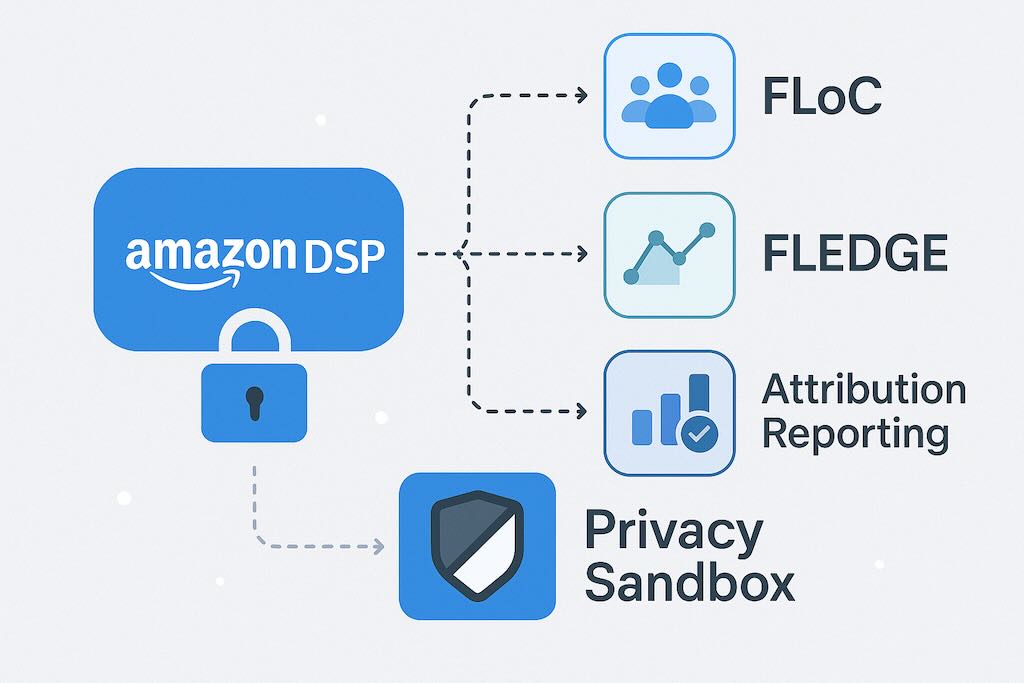
Editorial Update (March 2026): Since this article was originally published, Google has officially abandoned the Privacy Sandbox initiative, reversing its plan to deprecate third-party cookies in Chrome. While the Privacy Sandbox APIs remain technically available, they are no longer part of a mandatory transition. This article has been updated to reflect that shift and to examine how Amazon DSP’s broader attribution strategy—built on first-party data and AI—positions it well regardless of cookie deprecation timelines.
Amazon DSP integrated Google Privacy Sandbox technology into its advertising measurement suite in early 2025, providing enhanced attribution capabilities for Chrome users who reject third-party cookies while expanding cookieless advertising solutions across 25 countries including North America, Europe, and key emerging markets. Though Privacy Sandbox’s future is now uncertain, this integration demonstrated Amazon’s strategic foresight: the company built measurement infrastructure that functions with or without cookies, leveraging its Ad Relevance AI solution and first-party shopping data to maintain comprehensive campaign visibility across all browser environments.
The Original Privacy Sandbox Integration
When Amazon DSP first announced its Privacy Sandbox integration, the move addressed what appeared to be an imminent industry shift. Chrome held roughly 65% global browser market share, and Google’s stated plan to deprecate third-party cookies threatened to eliminate the primary tracking mechanism for billions of ad impressions. Amazon’s response combined Privacy Sandbox APIs with its existing Ad Relevance solution—an AWS-powered AI system that serves relevant advertisements and measures campaign effectiveness without depending on ad IDs or third-party cookies.
The combined measurement approach leveraged Amazon’s first-party data ecosystem—shopping behavior, Prime membership signals, and device usage patterns—alongside Privacy Sandbox APIs to deliver conversion attribution. This dual-system architecture ensured advertisers maintained visibility into campaign performance across all browser environments and user privacy preferences, complementing GA4’s enhanced e-commerce measurement capabilities. The geographic rollout covered the United States, Canada, Mexico, Brazil, major European markets including Germany, Spain, France, Italy, the United Kingdom, and Nordic countries, plus Middle Eastern markets such as Turkey, UAE, Saudi Arabia, Israel, Egypt, and Morocco.
Privacy Sandbox Abandoned: What This Means for Amazon DSP
In a dramatic reversal, Google ended its six-year Privacy Sandbox initiative and confirmed that third-party cookies will remain in Chrome indefinitely. The decision, driven by regulatory pushback from the UK’s Competition and Markets Authority (CMA) and widespread industry criticism of the Topics API and Attribution Reporting API, means the cookie deprecation timeline that motivated Amazon’s integration no longer applies.
For Amazon DSP advertisers, this news is largely positive. Third-party cookies surviving means existing measurement workflows continue to function. But Amazon’s investment in cookieless infrastructure was far from wasted. Safari and Firefox already block third-party cookies by default, accounting for approximately 30% of global browser traffic. Apple’s App Tracking Transparency (ATT) framework has reduced mobile identifier availability by an estimated 62% on iOS. The privacy-first measurement capabilities Amazon built remain operationally critical for reaching users on these platforms.
More importantly, Amazon’s approach was never solely dependent on Privacy Sandbox. The company’s Ad Relevance AI and first-party data graph provide attribution capabilities that function independently of any browser-level API. Amazon DSP can deterministically match ad exposures to purchases using its authenticated user base of over 310 million active customer accounts—a capability no Privacy Sandbox API could replicate.
Amazon DSP Attribution Methods: Marketing Cloud and Clean Rooms
Amazon’s attribution strategy extends well beyond browser-based measurement. Amazon Marketing Cloud (AMC), the company’s clean room analytics platform, has become the centerpiece of its privacy-compliant measurement offering. As of November 2025, Amazon expanded AMC access to all advertisers running sponsored ad campaigns—not just DSP users—democratizing access to sophisticated cross-channel attribution.
Key AMC capabilities for 2026 include:
- Multi-Touch Attribution (MTA) in beta: Distributes conversion credit across the full advertising journey instead of assigning 100% to the final ad interaction. Currently available to US advertisers, this model reveals how upper-funnel awareness campaigns influence lower-funnel conversions.
- Shopping-signal enhanced last-touch attribution: Launched January 1, 2026, this model retired the previous 14-day view-through window in favor of machine learning that determines whether an ad actually influenced a purchase. The system focuses on early discovery moments such as exploratory browsing and general category searches.
- Extended lookback window: AMC expanded its ad traffic lookback from 13 months to 25 months, giving advertisers more than two full calendar years of historical data. The feature launched in the US and Canada in November 2025, with European markets following in Q1 2026.
- No-code analytics interface: A new drag-and-drop query builder allows marketers without SQL expertise to run custom attribution analyses, audience segmentation, and conversion path reports.
- Clean room data matching: Brands can upload first-party CRM data and match it against pseudonymized Amazon signals in a privacy-safe environment, enabling custom audience creation and closed-loop measurement without exposing individual user data.
The clean room approach addresses a structural limitation of browser-based solutions like Privacy Sandbox: they only measure what happens in the browser. Amazon’s clean room connects online ad exposure to offline and cross-device purchase behavior, providing a more complete attribution picture that accounts for the full customer journey from awareness through conversion.
Platform Comparison: Amazon DSP vs Google DV360 vs Meta
The three dominant advertising platforms have taken divergent approaches to attribution and privacy compliance. The following comparison reflects capabilities as of Q1 2026:
| Feature | Amazon DSP | Google DV360 | Meta Ads |
|---|---|---|---|
| Attribution Model | Shopping-signal enhanced last-touch + MTA beta | Data-driven attribution via Campaign Manager 360 | 7-day click / 1-day view (reduced from 28-day) |
| Primary Data Source | First-party purchase data (310M+ accounts) | Search intent + Google account signals | In-app engagement + Conversions API |
| Cookieless Readiness | High — Ad Relevance AI + authenticated graph | Medium — relies on Privacy Sandbox remnants + Google login | High — server-side Conversions API |
| Clean Room | Amazon Marketing Cloud (AMC) | Ads Data Hub | Advanced Analytics (limited) |
| Closed-Loop Sales | Yes — direct purchase attribution on Amazon | No — requires third-party sales data | No — requires offline conversion uploads |
| Cross-Device Tracking | Deterministic via Amazon account graph | Probabilistic + Google account | Deterministic within Meta ecosystem |
| Lookback Window | Up to 25 months (AMC) | Up to 90 days (CM360) | 7 days click / 1 day view |
| Minimum Spend | $10,000–$35,000/month typical | No minimum (self-serve) | No minimum |
Amazon DSP’s key differentiator remains closed-loop attribution—the ability to directly connect ad exposure to product purchases without relying on pixels, cookies, or probabilistic matching. Google DV360 offers unmatched scale across the open web and YouTube inventory, but its attribution increasingly depends on users being logged into Google accounts. Meta’s strength lies in social engagement data and its server-side Conversions API, which bypasses browser restrictions entirely but only measures outcomes within Meta’s ecosystem unless advertisers implement manual offline conversion uploads.
Cookieless Advertising Strategies That Still Work
Despite Google’s reversal on cookie deprecation, the broader industry trajectory toward privacy-first advertising continues. Safari, Firefox, and Brave already block third-party cookies. Regulatory frameworks including GDPR, the Digital Markets Act, and state-level US privacy laws increasingly restrict cross-site tracking. Advertisers who rely solely on third-party cookies face measurement gaps across 30% or more of web traffic. Research from DoubleVerify and IAS published in 2025 found that contextual ads perform within 5–8% of behavioral targeting on click-through rates and within 10–12% on conversion quality.
Strategies delivering measurable results in 2026 include:
- First-party data activation: Email signups, purchase history, loyalty programs, and on-site behavior form the foundation of cookieless targeting. Platforms like Amazon DSP and Meta leverage authenticated user graphs built on this data to deliver deterministic audience matching.
- Server-side tracking: Google Tag Manager’s server-side container and Meta’s Conversions API send events directly from advertiser servers to ad platforms, bypassing browser-based ad blockers and privacy restrictions. Industry benchmarks show server-side tracking recovers 15–30% of conversion signals lost to browser-level blocking.
- Contextual targeting with AI: Machine learning and natural language processing now analyze page sentiment, media type, and topic relevance in real time. This approach shows ads based on content context rather than user profiles—an approach that privacy-focused analytics platforms like Fathom have long advocated.
- Retail media networks: Amazon, Walmart, Instacart, and Target collectively offer advertisers access to purchase-intent data within closed ecosystems. These networks provide attribution without cookies by matching ad exposure to actual transactions within their platforms.
- Data clean rooms: Beyond AMC, platforms including Google Ads Data Hub, LiveRamp, and InfoSum allow advertisers to match first-party data against publisher data in privacy-safe environments without exposing raw user information.
Industry Perspective
Amazon Ads has stated that “the future of programmatic, full-funnel media buying will be defined by the transformative power of AI,” noting that advertisers seeking to maximize campaign efficiency across the digital landscape will depend on AI-powered solutions. The company’s 2026 roadmap includes Full Funnel Campaigns and an AI-powered Ads Agent tool designed to automate campaign optimization across Amazon DSP, reflecting a broader shift from manual targeting to algorithmic audience discovery.
Neal Richter, Director of Bidding Science and Engineering at Amazon Ads, has emphasized that Amazon’s Authenticated Graph—which matches verified user identities rather than probabilistic browser signals—can now reach most US households by combining first-party and third-party supply. This reach advantage, combined with deterministic purchase attribution, positions Amazon DSP as arguably the most privacy-resilient major advertising platform available to marketers in 2026.
The broader lesson from Google’s Privacy Sandbox reversal is clear: the industry cannot depend on browser vendors to define measurement standards. Platforms with direct consumer relationships and first-party transaction data—Amazon chief among them—hold structural advantages that no browser API can replicate. Advertisers investing in first-party data infrastructure, server-side measurement, and clean room analytics are building capabilities that will remain valuable regardless of how cookie policies evolve in the years ahead.